Did you know that 70% of online shopping carts are abandoned, costing businesses around $18 billion annually? The good news: AI-powered timing strategies can recover up to 58% of these lost sales by reaching out at the perfect moment. Here’s how it works:
- Why Timing Matters: Shoppers are more likely to complete purchases when contacted shortly after abandoning their carts. Delays reduce interest and conversions.
- AI’s Role: AI analyzes real-time behavior, like browsing patterns and cart value, to determine the best time and channel (email, SMS, etc.) for follow-ups.
- Proven Results: Businesses using AI have seen cart recovery rates increase by 30–40%, boosting revenue significantly.
- Best Practices: Start with immediate reminders, follow up within hours, and add urgency (e.g., limited-time offers) within 24 hours.
With AI tools, you can recover lost revenue without overwhelming customers. The key is precise timing tailored to each shopper’s behavior.
How AI Optimizes Timing for Cart Recovery
How AI Identifies the Best Timing
AI tools are like digital detectives, constantly observing customer behavior in real time. They track everything – what products people view, how long they stay on a page, whether they use discounts, their browsing habits, and even the exact moment they abandon their carts. All of this information feeds into predictive models that figure out the best time to reach out and bring those customers back.
These predictive algorithms dig deep, analyzing subtle cues like scrolling speed, time spent on specific pages, and past site activity. For instance, AI chatbots can sense when someone hesitates on a payment page or moves their mouse toward the close button. In those critical moments, the chatbot might jump in with a free shipping offer or quick answers about delivery times, acting in mere milliseconds to prevent a lost sale. A great example of this comes from Bloomreach‘s AI platform, which, in July 2025, demonstrated how it could learn individual customer habits – like when they’re most likely to engage with emails – and time recovery messages accordingly. This kind of precise timing has been shown to boost cart recovery rates by 30–40% compared to traditional methods. But how does AI gather all these insights? That’s where its ability to interpret a wide range of signals comes into play.
User Signals That AI Analyzes
AI systems create detailed customer profiles by piecing together a variety of signals. Real-time behavioral cues include things like exit intent (such as moving the mouse toward the browser’s close button), rapid scrolling, pauses that suggest confusion, or switching tabs to compare prices. Beyond these immediate actions, the system also looks at customer history – such as past purchases, browsing behavior, and whether someone is a first-time visitor or a returning customer. On top of that, cart-specific details like the total value, selected items, and product preferences help paint a clearer picture of the shopper’s intent. Even engagement data from earlier recovery attempts, like whether emails were opened or links were clicked, fine-tunes future outreach efforts.
By connecting with your CRM, e-commerce platform, and product catalog, AI systems gain a unified view of each customer. This allows them to adjust messaging and timing based on factors like how sensitive a shopper is to discounts, their location, and even their preferred device. And all of this happens while respecting privacy rules, using only first-party data and explicit permissions.
AI Timing Across Multiple Channels
AI doesn’t just optimize timing for a single channel – it coordinates recovery efforts across email, SMS, browser notifications, social media retargeting, and even voice messaging. It carefully manages how often messages are sent and ensures they’re consistent across platforms. For U.S. shoppers, time-zone adjustments are key. For example, someone in New York might get an SMS at a different time than a shopper in Los Angeles, even if both abandoned their carts at the same moment.
In June 2025, a mid-sized fashion retailer implemented an AI-powered recovery system combining behavioral insights with a three-step, multi-channel strategy – email, SMS, and browser notifications. The results were impressive: their cart recovery rate jumped from 7.5% to 23.8%, adding $1.2 million in annual revenue and delivering a 980% return on their technology investment.
This multi-channel approach highlights how AI can dynamically optimize outreach to recover lost revenue, ensuring every message is perfectly timed and tailored to the customer’s preferences.
Designing an AI-Optimized Cart Recovery Timeline
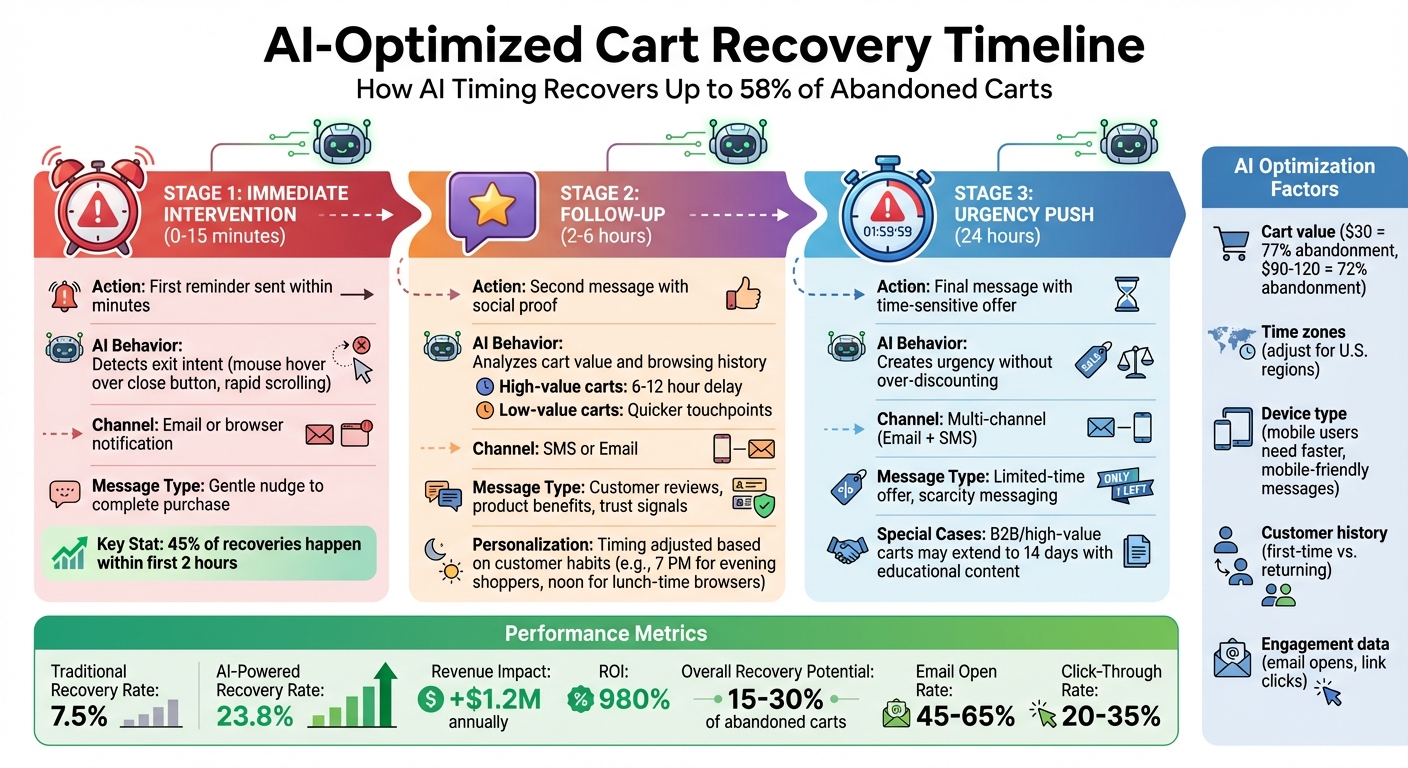
AI-Powered Cart Recovery Timeline: 3-Stage Strategy with Performance Metrics
Stages of a Cart Recovery Timeline
When it comes to cart recovery, timing is everything. Thanks to AI’s ability to analyze user behavior in real time, recovery strategies can be fine-tuned to address different abandonment scenarios. Broadly speaking, there are two main approaches: immediate interventions that occur as shoppers hesitate and reactive follow-ups after they’ve left the site. For example, AI can detect when a user shows signs of leaving – like hovering over the exit button – and trigger a timely message to encourage them to stay.
Once a cart is abandoned, the recovery process usually unfolds in a few key phases. The first message, sent within minutes, serves as a gentle nudge to remind shoppers to finish their purchase. A second follow-up arrives a few hours later, often incorporating elements like customer reviews or emphasizing product benefits to build trust and renew interest. The final message, typically sent around 24 hours later, introduces urgency – perhaps by highlighting a limited-time offer – to push for conversion. This phased approach is crucial, as nearly half (45%) of recoveries happen within the first two hours. With this framework in place, AI can step in to make real-time adjustments, which we’ll explore next.
How AI Adjusts Timing for Each Stage
AI doesn’t follow a rigid playbook – it adapts to individual customer behavior to maximize engagement. For instance, if a cart holds high-value items, follow-ups might stretch to 6–12 hours, allowing more time for consideration. Lower-value carts, on the other hand, might benefit from quicker touchpoints. A great example of this flexibility comes from a B2B SaaS company in June 2025. They extended their recovery sequence to 14 days for high-value, complex carts, using educational content to address objections. The result? An 18% recovery rate and $850,000 in recovered annual recurring revenue.
AI also learns from customer habits. If someone consistently ignores morning emails but responds to messages later in the day, the system adjusts accordingly. In July 2025, Bloomreach Engagement illustrated this by scheduling recovery emails at 7 p.m. for evening shoppers and around noon for those active during lunch breaks. This strategy ensured messages landed when customers were most likely to engage. Between these touchpoints, AI fine-tunes messaging based on user actions, such as email opens or clicks, to keep the conversation relevant. These adaptive strategies are particularly effective when tailored to U.S. shopping habits.
Timing Best Practices for U.S. Markets
In the U.S., timing strategies need to account for unique shopping behaviors. Mobile users, for example, expect quick, mobile-friendly messages. Time zone differences are another critical factor – a message sent at the same time nationwide might not reach customers when they’re most likely to respond.
During major shopping events like Black Friday and Cyber Monday, timing becomes even more critical. Shorter intervals, ranging from 30 minutes to 12 hours, can help brands capture the heightened urgency of these periods. Cart value also plays a role in timing decisions. For instance, low-ticket items (under $30) face a 77% abandonment rate, while mid-range carts ($90–$120) see a slightly lower rate at 72%. Adjusting the timing to reflect these patterns can make a significant difference. Additionally, since late-night and evening hours often see the highest abandonment rates, scheduling recovery messages for mid-morning or early evening – peak engagement times – can boost results.
Implementing AI Timing in Cart Recovery Campaigns
Setting Up Abandonment Signals and Triggers
Effective AI timing starts with recognizing when a customer is about to leave. AI tools monitor real-time behaviors – like lingering on the payment page or moving the mouse toward the close button – to detect these exit signals. Once identified, these signals feed into the AI system, which determines the best moment to re-engage. By pulling data from your CRM, e-commerce platform, and product catalog – such as cart contents, browsing history, and past purchases – the system can prioritize which recovery efforts matter most. Setting a minimum cart value threshold can also help separate high-priority cases from those that can be addressed later. With these insights, AI establishes tailored timing rules designed to maximize recovery success.
Creating AI-Driven Timing Rules
Unlike traditional recovery methods that rely on fixed schedules, AI tailors outreach timing to each customer’s unique behavior. Using the detected abandonment signals, AI creates personalized timing rules based on factors like browsing patterns, price sensitivity, and purchase history. For example, if a customer tends to respond to emails in the evening, the AI adjusts its schedule to send messages during that time.
This personalized approach can have a big impact on recovery rates. In 2025, Shopware demonstrated that algorithm-driven decisions could save a store with 100,000 monthly visitors $3,037.50 per month by reducing unnecessary discount offers by up to 25%. The AI identified which customers genuinely needed incentives and which could be won over with a simple service message. Harald Neuner, Co-founder of uptain, illustrated the value of this approach:
Picture walking out of a clothing store, and instead of asking what went wrong – size, fit, service, or stock – the staff just throws a 10% voucher at everyone heading for the door. Helpful? Sometimes. Relevant? Rarely. Now imagine the opposite: knowing what customers are actually concerned about. Out of the hundreds of possible reasons to leave, what if you could identify the right one and respond with the right words, the right tone, and the right offer at exactly the right moment?
By addressing the real reasons for abandonment, AI-driven timing rules go beyond generic solutions and deliver meaningful results.
Building Multi-Channel Recovery Sequences
Once timing rules are in place, the next step is to create a seamless multi-channel recovery strategy. AI coordinates outreach across platforms like SMS, email, and voice, selecting the most effective channel based on customer preferences and past engagement. For instance, if a customer opens an email but doesn’t click through, the system might follow up with an SMS within a few hours. If there’s still no response, a voice call could serve as the final touchpoint.
The impact of this approach is clear. TxtCart’s AI-powered SMS recovery helped Joyride generate over $1 million in revenue with a 20x ROI. Similarly, Lush Beauty recovered 2,106 orders and over $515,000 in revenue in just 28 days using a similar strategy. Another success story comes from Chaser, an LA-based fashion brand, which generated $207,341 in SMS-attributed revenue through over 10,983 customer conversations. This effort resulted in a 42.78% reply rate and more than 1,100 orders. The key is letting AI manage the frequency and consistency of messages, ensuring a cohesive communication flow without overwhelming the customer.
For businesses hesitant about upfront costs, platforms like Unselfish AI offer performance-based solutions. These platforms integrate SMS, email, and voice outreach, with payment tied directly to the revenue recovered, making it easier to adopt this powerful strategy.
sbb-itb-3bca853
Measuring and Refining AI Timing Performance
Metrics for Evaluating Timing Strategies
To understand how well AI-driven timing strategies are working, you’ll want to focus on a few key metrics. One of the most telling is the recovery rate, which shows the percentage of abandoned carts successfully recovered. Another is revenue per recipient (RPR), a measure of how much revenue each recovery effort generates on average. For reference, AI-powered recovery efforts tend to achieve email open rates of 45–65% and click-through rates of 20–35%. Compare that to basic recovery strategies, which typically see open rates of 30–40% and click-through rates of 10–15%. On average, abandoned cart flows yield an RPR of $3.65.
It’s also worth tracking recovery performance without relying on discounts. This can help you gauge whether your timing strategy alone is enough to draw customers back. Set clear benchmarks for these metrics and review them weekly to identify patterns or shifts over time. These insights will guide you as you test and refine your timing strategies.
Testing Different Timing Strategies
AI thrives on experimentation, making it an invaluable tool for fine-tuning your timing approach. A/B testing is a great way to start. For example, you can compare short delays (like sending a follow-up 30 minutes after cart abandonment) with longer delays (such as waiting 4–6 hours) to see which timing captures more customer interest. You can also test different message sequences – say, a three-step approach involving email, SMS, and a voice message versus a simpler two-step sequence.
Beyond timing, experiment with other variables like subject lines (personalized versus generic), offer types (discounts versus free shipping), and message lengths (concise versus detailed). The beauty of AI is that it doesn’t just collect data – it actively learns from these tests and adjusts the timing rules automatically based on what delivers the best results. This constant refinement helps ensure your recovery efforts stay effective.
Using AI to Continuously Improve Timing
AI doesn’t just stop at initial testing – it keeps learning and evolving. By analyzing real-time feedback, it fine-tunes timing strategies to match customer behavior. For instance, AI might notice that a specific group of customers consistently responds to evening messages and adjust the schedule accordingly. It can even trigger immediate actions when it detects high-intent behaviors, like a customer revisiting their abandoned cart.
A great example of this in action comes from a leading home goods retailer. In 2025, they introduced AI-driven cart recovery and saw their recovery rate jump from 8% to 27% in just three months. This resulted in an additional $840,000 in annual revenue – all while keeping discounts to a minimum. AI achieves this by continuously monitoring performance data, identifying successful strategies, and adapting its timing ahead of key shopping seasons like Black Friday or back-to-school sales. The result? Smarter, more effective recovery efforts that evolve alongside customer needs.
Compliance and Customer Experience Considerations
U.S. Compliance Requirements
When using AI to send cart recovery messages, following compliance regulations isn’t just recommended – it’s mandatory. For SMS, the Telephone Consumer Protection Act (TCPA) requires strict consent management. This means customers must explicitly opt in before receiving automated messages. As TxtCart explains:
Most ecommerce brands are one campaign away from a $1,500 fine. SMS quiet hours aren’t just a "nice-to-have" compliance checkbox.
Each violation comes with a hefty fine, making non-compliance an expensive mistake.
Another key compliance consideration is respecting SMS quiet hours, which restrict the times when messages can be sent. In Texas, for instance, Senate Bill 140 (effective September 1, 2025) broadens the definition of "telephone solicitation" to include texts, MMS messages, and calls, adding further requirements for businesses operating in the state. For email campaigns, the CAN-SPAM Act lays out regulations, with penalties reaching as high as $53,088 per violation.
Unselfish AI simplifies compliance by offering built-in features like consent management and opt-in verification, ensuring businesses meet TCPA and CAN-SPAM standards.
Balancing AI Timing with Customer Experience
Once compliance is covered, the next step is optimizing how and when you engage with customers. AI can help by analyzing customer behavior, such as lingering on the checkout page or revisiting a cart multiple times. This ensures outreach targets genuine hesitation rather than blanketing every visitor with messages.
The key is to frame your communication as helpful rather than pushy. Not every message needs to include a discount – sometimes, a simple reminder about free returns or dependable delivery can ease concerns and close the sale. Personalization plays a huge role here. Research shows that 76% of consumers are more likely to buy from brands that tailor their experience, while the same percentage is frustrated by generic messaging. Modern AI tools respect privacy by working with first-party data and explicit permissions, enabling meaningful personalization without crossing ethical boundaries.
Managing Frequency and Message Fatigue
Even with personalized outreach, getting the frequency right is critical to keeping customers engaged without overwhelming them. AI helps by setting limits on how often messages are sent and adapting based on how recently a customer has interacted with your brand.
Advanced algorithms take this further by analyzing behaviors like mouse movements, time spent on a page, and tab switching to identify true exit intent. This minimizes unnecessary interventions and ensures messages are relevant. When a customer continues to face challenges or engages repeatedly, AI can escalate the issue to a live agent. This approach not only reduces frustration but also boosts satisfaction, encourages repeat purchases, and strengthens brand loyalty.
Conclusion
Cart abandonment represents a massive revenue gap, with U.S. and EU companies standing to recover an estimated $260 billion annually by addressing it effectively. The key to regaining this lost revenue lies in precise timing. Using AI-driven strategies, businesses can shift from merely reacting to abandoned carts to proactively engaging customers at the perfect moment and through the ideal channel.
AI-powered solutions have proven to recover 15–30% of abandoned carts, delivering an impressive ROI of 800–1,200%. These results stem from AI’s ability to evaluate customer behavior in real time, predict when abandonment might occur, and send perfectly timed messages through channels like email, SMS, and voice.
With Unselfish AI, businesses can seamlessly implement these strategies to re-engage customers across multiple channels – all on a pay-for-results model. The platform takes care of everything, from behavioral triggers and compliance to adjusting timing dynamically, so businesses can concentrate on growth while leaving the technical details in capable hands.
FAQs
How does AI decide the best time to recover abandoned shopping carts?
AI pinpoints the best moments to recover abandoned shopping carts by analyzing how customers interact with a website. It looks at details like how long shoppers stay on certain pages, how they scroll, where their cursor moves, and even signals that suggest they might leave soon. Using this data, AI predicts when someone is about to disengage and sends personalized messages or offers to bring them back.
These responses happen almost instantly – often within seconds or minutes – boosting the chances of turning an abandoned cart into a completed purchase. This well-timed approach not only helps businesses regain lost sales but also provides shoppers with a smooth, hassle-free experience.
What legal and privacy factors should I consider when using AI for cart recovery?
When leveraging AI for cart recovery, keeping privacy laws like GDPR and CCPA in mind is a must. Make sure to obtain clear, explicit consent from customers before collecting or using their data. Be upfront about how their information is stored and managed to maintain transparency.
It’s equally important to have solid cookie management practices in place. Respect user preferences, whether it’s opting out or unsubscribing, and handle customer data with care. Using data responsibly not only builds trust but also helps steer clear of legal complications.
How does AI improve multi-channel strategies to recover abandoned carts?
AI takes cart recovery to the next level by analyzing customer behavior to determine the most effective timing and methods for outreach. It tailors messages and automates communication across various platforms like email, SMS, push notifications, and retargeting ads.
By sending messages that align with each customer’s engagement habits, AI ensures outreach happens at the right moment. This strategy can dramatically improve recovery rates and help businesses recover lost revenue more efficiently.