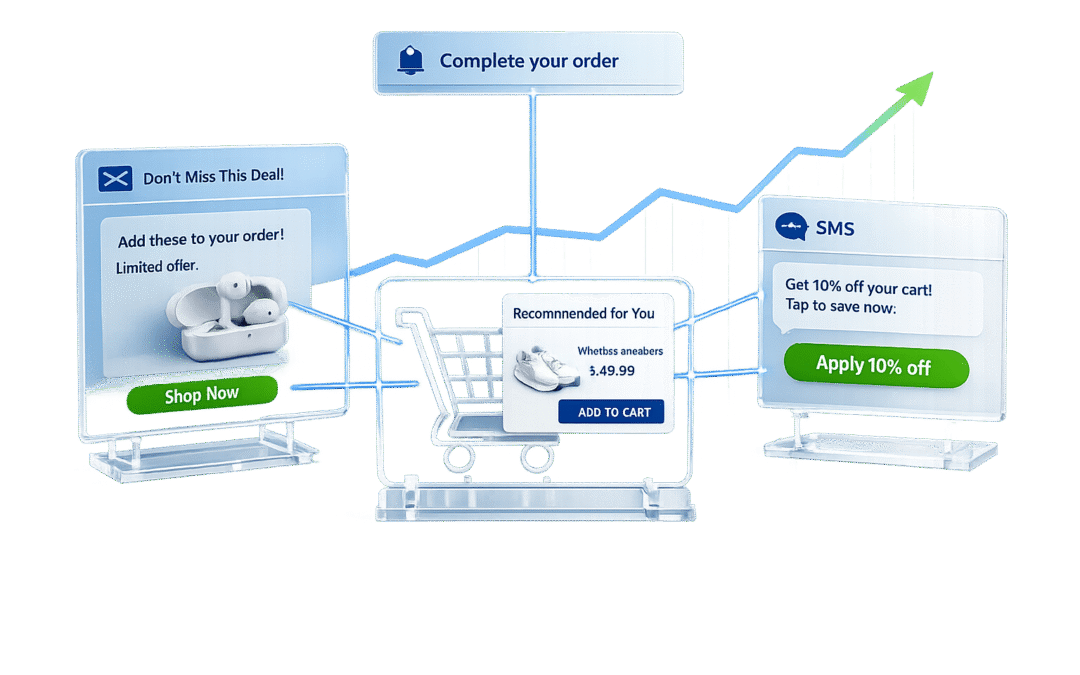
70% of online shopping carts are abandoned, leading to billions in lost sales. AI-powered upselling transforms these missed opportunities into revenue by using real-time, personalized strategies to recover carts and boost order value.
Here’s how it works:
- Real-Time Personalization: AI analyzes browsing behavior, cart contents, and trends to suggest relevant products or bundles during recovery.
- Higher Engagement Rates: AI-driven recovery emails see 2.1× higher click-through rates than traditional reminders, with merchants reporting 10–26% increases in Average Order Value (AOV).
- Multi-Channel Outreach: SMS, WhatsApp, and Voice AI enable businesses to engage customers across platforms, addressing concerns like shipping costs or product fit instantly.
- Behavioral Triggers: AI detects hesitation signals (e.g., pauses, tab switching) and intervenes with tailored offers or assistance to prevent abandonment.
For example, fashion brand Bonny & Read achieved a 26.06% AOV boost and a 54.75% upsell acceptance rate in 2025 using AI-driven recovery strategies. Tools like Unselfish AI make implementation simple, offering performance-based pricing – businesses only pay when sales are recovered.
AI-powered upselling doesn’t just recover carts – it maximizes revenue and builds stronger customer relationships.
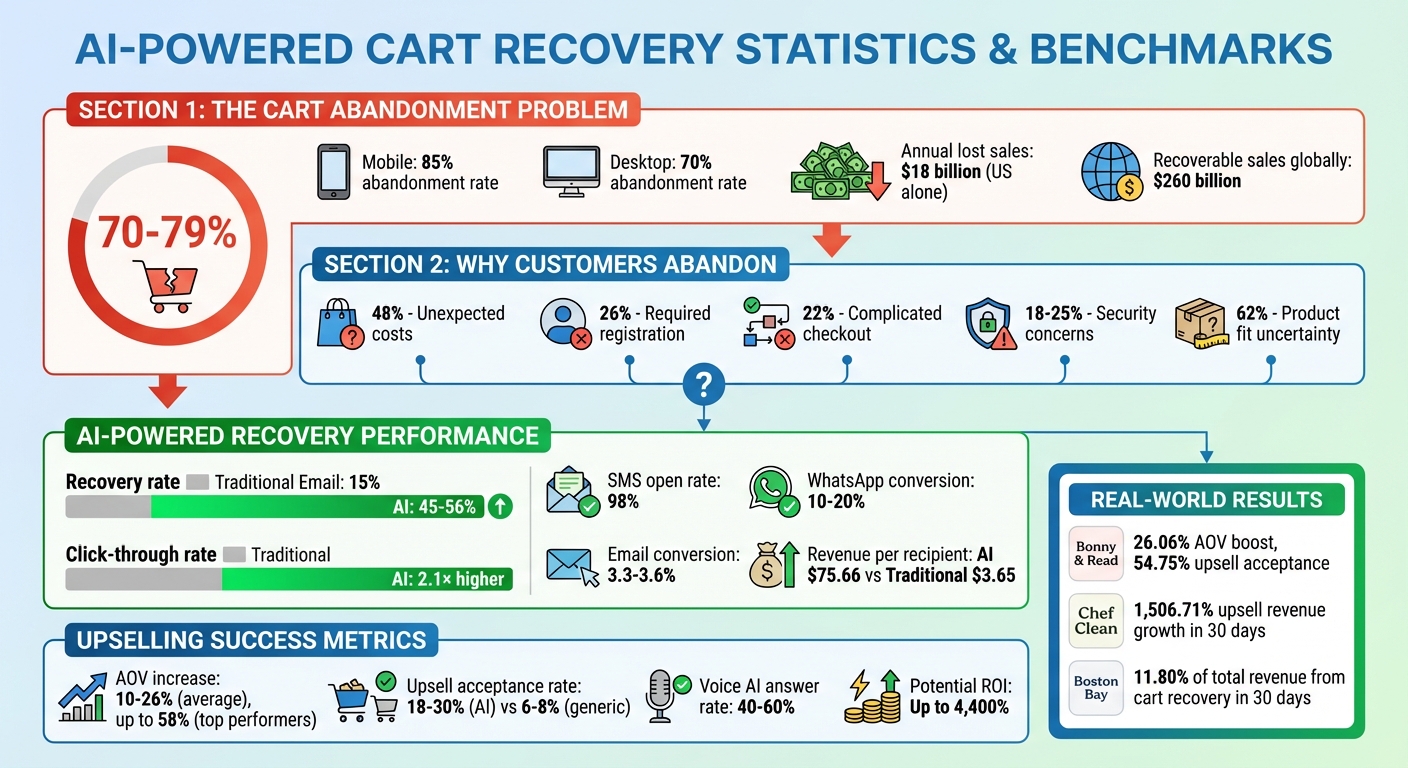
AI-Powered Cart Recovery: Key Statistics and Performance Benchmarks
Cart Abandonment and Upselling Opportunities
Why Customers Abandon Carts
Did you know that nearly 70–79% of online shopping carts were abandoned in 2026? The numbers are even higher for mobile users, with a staggering 85% compared to 70% for desktop shoppers. This adds up to an eye-popping $18 billion in lost sales every year in the US alone.
So, why do shoppers abandon their carts? The reasons vary but tend to revolve around a few common frustrations:
- Unexpected costs: 48% of shoppers cite this as their reason.
- Required registration: 24–26% of users find this off-putting.
- Complicated checkout processes: Multi-step checkouts drive away 22% of shoppers.
- Security concerns: Affecting 18–25% of users.
But it’s not just about pricing or process issues – 62% of shoppers leave their carts because they’re unsure if the product is the right fit. For many, the cart becomes a digital wishlist rather than a commitment to buy.
Some brands are already tackling these challenges head-on. For instance, in January 2026, UPLIFT Desk streamlined their checkout experience by adding Fastlane by PayPal, which cut down on unnecessary clicks and auto-filled saved details, making the process smoother. ZQuiet took a different approach, replacing a generic "10% off" exit popup with an interactive quiz. This quiz helped visitors find the right FDA-cleared solution, turning a potential cart abandonment into an opportunity for personalized guidance.
Understanding these triggers is essential for developing strategies to recover lost sales and, even better, to boost transaction value through upselling.
How Upselling Works in Cart Recovery
AI is changing the game when it comes to cart recovery. What used to be simple recovery emails are now becoming dynamic sales opportunities, thanks to real-time data analysis. AI-powered upselling doesn’t just remind shoppers about their abandoned items – it goes a step further, analyzing browsing behavior and cart contents to suggest tailored alternatives or bundles.
Here’s why this matters: merchants who use AI-driven upselling in their recovery flows have seen average order values (AOV) increase by 10–26%. Even more impressive, upsell acceptance rates jump from 6–8% with generic reminders to 18–30% when personalized recommendations are used. A great example? In 2025, Boston Bay added upselling features to their cart and email recovery strategies, generating 11.80% of their total revenue in just 30 days.
Timing is everything. AI upselling addresses the shopper’s uncertainty right when they’re reconsidering their purchase. And it’s not just about emails – SMS recovery messages, for example, boast an incredible 98% open rate and convert 10–15% of abandoned carts. By using multiple channels, brands can deliver recommendations where and when customers are most likely to act.
"Cart abandonment isn’t a bug in ecommerce – it’s a feature. Customers use carts to browse, compare, and save items. The key is bringing them back." – Baymard Institute
These strategies not only recover lost sales but also set the stage for more sophisticated AI-driven interventions, which we’ll explore in the next sections.
AI Techniques for Upselling During Cart Recovery
AI uses subtle behavioral cues to deliver upsell offers at just the right moment. By analyzing actions like mouse movements and pauses during typing, it can predict when a shopper is about to leave – often just 2–4 seconds before they actually do. Let’s explore three key AI-driven approaches that make upselling during cart recovery more effective.
Predictive Analytics for Personalization
"Next Best Offer" modeling is a game-changer for upselling. By analyzing purchase history, browsing habits, and session activity, AI assigns an abandonment score to each shopper. This score helps determine what type of incentive – like free shipping, a product swap, or a simple reminder – will be enough to keep the shopper engaged. And the results speak volumes: 49% of customers make unplanned purchases after receiving tailored recommendations.
AI also uses identity resolution to track customers across devices. This ensures a seamless understanding of their preferences, whether they’re shopping on a laptop or a phone.
Dynamic Product Bundling
While personalization focuses on individual offers, dynamic bundling creates tailored group recommendations. This isn’t your old-school “camera and tripod” combo. Today’s AI systems analyze cart contents and browsing behavior to suggest add-ons that complement the main purchase. For instance, if someone buys a coffee grinder, the AI might suggest a cleaning brush and precision scale rather than an unrelated item like a mug.
A great example of this in action is Chef Clean, which used AI-powered popups and email upselling to boost upsell revenue by an incredible 1,506.71% in just 30 days.
"The era of static, cookie-cutter bundling is ending, and customers are catching on. They don’t want suggestions that feel automated; they want experiences that feel intuitive, personal, and genuinely helpful." – Erin Murray, Strategy & Growth Expert, Pyxl
Real-Time Behavioral Triggers
AI takes upselling to the next level by responding to real-time shopper behavior. By monitoring checkout actions, it can spot hesitation and act immediately. For example, if someone lingers over shipping costs, the system might offer a dynamic shipping discount. Or, if a shopper keeps switching between sizes, AI could trigger a chatbot to provide a sizing guide or customer reviews.
Here’s how AI interprets common behaviors and responds:
| Behavioral Signal | AI Interpretation | Recommended AI Action |
|---|---|---|
| Fast upward scroll (mobile) | Intent to exit/back gesture | Trigger "Save Cart" or "Free Shipping" popup |
| Hovering over "Shipping Costs" | Price sensitivity/Shipping shock | Offer dynamic shipping discount or threshold nudge |
| Repeated size/variant changes | Uncertainty about fit | Trigger AI chatbot with sizing guide or reviews |
| Tab switching/Window defocus | Distraction/Comparison shopping | Send personalized SMS or Email reminder within 1 hour |
| Idle for 30–60s at payment | Technical friction or trust gap | Launch real-time chat assistant to offer help |
These targeted actions are far more effective than generic solutions. For instance, AI-powered exit-intent popups convert at rates of 6–10%, compared to just 2–4% for basic discount popups. And when it comes to recovery messages, SMS shines with open rates as high as 98%, converting at two to three times the rate of traditional email. By addressing specific pain points in real time, AI ensures a smoother path to purchase.
Unselfish AI Solutions for Cart Recovery and Upselling
Unselfish AI offers a fresh approach to cart recovery by combining multi-channel automation with a pricing model that’s entirely performance-based. By leveraging SMS, email, and Voice AI, the platform re-engages shoppers who abandon their carts through natural, human-like conversations and real-time automated calls. By sequencing outreach across multiple touchpoints, it significantly boosts the chances of converting abandoned carts into completed sales.
Cart Abandonment Recovery Features
Unselfish AI’s text bots handle SMS conversations, automating follow-ups, upselling opportunities, and customer re-engagement. Their Voice AI technology adds another layer by making automated calls that sound natural, qualify leads, deliver reminders, and gather essential data. Considering SMS open rates hover around 98%, this multi-channel strategy far outperforms traditional email-only recovery efforts.
What makes Unselfish AI stand out is how quickly and easily it can be implemented. Their team designs custom workflows using your CRM data or cart behavior tracking, allowing campaigns to go live in less than a week. Plus, the entire process is managed by the Unselfish AI team, freeing you up to focus on other aspects of your business.
This system doesn’t just recover abandoned carts – it also creates upselling opportunities, aligning perfectly with AI’s role in driving revenue growth. To top it off, Unselfish AI’s automation tools are paired with a pricing model that ensures you only pay for results.
Performance-Based Pricing Model
Unselfish AI’s pricing is straightforward: you pay nothing upfront. Costs are incurred only when the AI successfully recovers revenue, schedules a call, or re-engages a dormant customer. If there’s no success, there’s no cost. This approach ensures a guaranteed return on investment while allowing businesses to scale their outreach efforts without hiring additional staff or paying fixed software fees.
"We recover revenue. You get booked calls, sales, or revived conversations. That’s when we get paid." – Unselfish AI
sbb-itb-3bca853
Key Metrics for Measuring Success
When it comes to AI-powered cart recovery campaigns, the right metrics can reveal whether you’re truly driving growth or just scratching the surface. These metrics help separate impactful upselling strategies from routine recovery efforts. For instance, measuring incremental revenue is crucial to understanding the real effect of AI interventions. Studies show that 20–40% of shoppers who abandon their carts will return and purchase on their own, so it’s important to distinguish the influence of your AI-powered efforts from natural buyer behavior.
One essential metric is the Upsell Acceptance Rate, which tracks how often shoppers add recommended products to their carts. Top-performing campaigns achieve rates between 18–30%. Another important measure is the Attach Rate, which reflects the percentage of orders that include upsell products.
Revenue Per Recipient is another revealing metric, showing how much revenue each recovery message generates. While traditional email campaigns average $3.65 per recipient, AI-powered efforts can skyrocket this figure to $75.66 – an incredible 2,000% increase. This metric also highlights channel effectiveness. For example, WhatsApp recovery messages boast conversion rates of 10–20%, significantly outperforming email’s 3.3–3.6% average.
The AOV Lift (Average Order Value Lift) measures how much upselling boosts the average order value. AI-driven campaigns often see increases of 10–26%, with top performers achieving lifts as high as 58%. Equally important is the Recovered Orders Rate, which tracks the percentage of abandoned carts that are converted into completed orders. AI-powered systems typically recover 45–56% of abandoned carts, far surpassing the 15% recovery rate of traditional email campaigns.
These metrics provide a clear picture of how real-time, personalized upselling strategies impact your bottom line. Below are some key benchmarks to help you evaluate your campaign’s performance:
Metrics and Benchmarks
| Metric | Description | Target Benchmark |
|---|---|---|
| Upsell Acceptance Rate | Percentage of AI recommendations resulting in add-to-cart actions. | 18–30% |
| Attach Rate | Percentage of orders that include upsell products. | Varies by industry |
| Recovered Orders Rate | Percentage of abandoned carts converted into completed orders. | 45–56% (AI-powered) |
| AOV Lift | Increase in average order value due to upselling. | 10–26% (average); 58% (top performers) |
| Revenue Per Recipient | Revenue generated per recovery message sent. | $3–$8 (email); up to $75.66 (AI) |
| Cart Abandonment Rate | Percentage of shoppers who abandon their carts after initiating checkout. | ~70% (industry average) |
| Email Open Rate | Percentage of recovery emails opened by recipients. | 39–45% (average); 50–52% (top performers) |
| Click-Through Rate (CTR) | Percentage of email recipients who click on a link. | 6–10% (average); 21–23% (top performers) |
These benchmarks serve as a guide to understanding the effectiveness of your AI-powered recovery campaigns and identifying areas for improvement.
Implementation and Advanced Strategies
Setting up AI-powered upselling is surprisingly quick and straightforward. Modern solutions, like those compatible with Shopify or WooCommerce, use real-time monitoring to detect cart abandonment and integrate seamlessly via APIs. In fact, most systems can be up and running in under 30 minutes with no-code editors.
The key to success lies in timing. Instead of bombarding customers with immediate messages, implement a strategic delay. Allow a grace period of 1 to 4 hours after cart abandonment, giving customers time to complete their purchase naturally. Before reaching out, re-check the checkout status to confirm the order is still incomplete. During this window, AI works behind the scenes, analyzing cart contents, browsing habits, and popular products to suggest complementary items or alternatives likely to convert.
Steps to Implement AI-Powered Upselling
First, connect your e-commerce platform to the AI system using native integrations. This ensures real-time access to crucial data like inventory, pricing, and customer behavior. Next, define your profit safeguards. For instance, set rules that limit discounts to a maximum of 10% or enable free shipping only for orders exceeding $50. These guardrails protect your margins while still offering enticing deals.
Your upselling strategy should also leverage multiple channels. For standard carts, start with SMS or email within the first hour. For higher-value carts, consider AI-driven voice outreach within 5 to 15 minutes to capture purchase intent while it’s still fresh. Dynamic incentives can further boost conversions. For example, offer free shipping if a customer’s cart is just $5 shy of the threshold, or apply a discount if the AI detects hesitation during a conversation.
Finally, track results. Use your CRM or analytics dashboard to monitor which upsell suggestions perform best and which communication channels deliver the highest ROI for different customer segments. This feedback loop helps refine your strategy over time.
Voice AI Outreach for Cart Recovery
Voice AI takes upselling to another level by transforming cart recovery into a two-way, personalized conversation. Unlike emails that might go unread for hours, AI voice agents reach customers within 15 to 30 minutes of abandonment, with answer rates ranging from 40% to 60%.
These calls are highly tailored. The AI references specific products, addresses shipping concerns, clarifies delivery timelines, and negotiates discounts within your predefined rules. For example, if a customer hesitates over pricing, the voice agent might suggest adding another item to qualify for free shipping – effectively turning a concern into an upsell opportunity. After the call, the system sends a "Magic Link" via SMS or WhatsApp, directing the customer to a pre-filled checkout page for a frictionless experience.
The potential revenue boost is significant. For a mid-market e-commerce store generating $1 million annually, AI voice recovery could add around $24,960 in extra revenue. With support for over 40 languages, this technology enables brands to connect with customers worldwide in their native language.
Before rolling out voice outreach, ensure compliance with TCPA regulations by obtaining documented prior express written consent during checkout.
For businesses new to cart recovery strategies, Unselfish AI’s pay-for-results model offers a low-risk way to test advanced voice AI without upfront costs.
Conclusion
Cart abandonment doesn’t have to spell lost revenue. With a staggering 70% of shopping carts abandoned worldwide – amounting to approximately $260 billion in recoverable sales each year – AI-powered upselling provides a clear way to turn hesitation into conversions.
What sets AI-driven strategies apart from traditional recovery methods? It’s all about timing, personalization, and intelligence.
Instead of sending out generic reminder emails hours after a cart is abandoned, AI works in real time. By analyzing cart contents and browsing behavior, it suggests relevant products or bundles that encourage customers to complete their purchase. Take Bonny & Read as an example: in Q3 2025, the fashion brand saw a 26.06% boost in average order value and a 54.75% upsell acceptance rate after incorporating AI-driven cart and email upselling. Another standout success is Chef Clean, which achieved a stunning 1,506.71% growth in upsell revenue within just 30 days by leveraging AI across multiple touchpoints.
The secret lies in pairing smart product recommendations with margin-conscious incentives and multi-channel outreach. AI voice agents, for instance, outperform traditional email flows by recovering three times as many carts. These agents engage customers within five to 15 minutes, using two-way conversations to address objections and encourage conversions. With potential ROI soaring to 4,400%, the benefits are hard to ignore.
For businesses looking to turn abandoned carts into revenue, Unselfish AI’s pay-for-results model offers a no-risk solution. By charging only when sales are successfully recovered, this approach provides an easy, cost-effective way to test advanced cart recovery and upselling strategies without requiring any upfront investment.
FAQs
How does AI know which upsell offer to show?
AI pinpoints the most effective upsell opportunities by diving into real-time shopper behavior and contextual clues. It considers details like browsing history, past purchases, current cart items, and engagement habits. Using machine learning models trained on historical sales data, it predicts which offers are likely to resonate with each shopper. Additional factors – such as location, device type, and time of day – fine-tune these recommendations, making them feel personalized and boosting the likelihood of a successful upsell.
When should cart recovery messages be sent?
Cart recovery messages work best when sent promptly – ideally within 30 to 60 minutes after a shopper leaves their cart. This timing alone can help recover up to 80% of potentially lost carts. Using personalized, timely follow-ups through email, SMS, or even chatbots can make a big difference in bringing customers back. Some approaches even recommend engaging shoppers in real time during their browsing session to improve recovery rates further.
How do I measure true incremental revenue from AI recovery?
To determine the real impact of AI on recovering abandoned carts, you need to measure the incremental revenue it generates. Start by comparing the revenue recovered through AI interventions to the baseline losses from cart abandonment. Here’s how to do it:
- Establish a control period: Use a timeframe without AI-driven recovery efforts to set a baseline for cart abandonment losses.
- Track revenue during AI campaigns: Monitor the revenue generated when AI tools are actively working to recover abandoned carts.
- Account for natural recovery: Subtract the revenue that would have been recovered without AI intervention (based on historical data or control group performance).
Key metrics to focus on include the additional revenue directly tied to AI actions and the incremental lift compared to previous recovery rates. These will help you clearly quantify AI’s contribution to revenue growth.