AI is transforming how businesses recover lost revenue by automating outreach across email, SMS, and voice channels. Here’s the main takeaway: AI helps businesses re-engage leads, recover abandoned carts, and reduce missed opportunities – all while saving time and improving efficiency.
Key points:
- Revenue leaks are common: 70% of online shopping carts are abandoned, costing $18 billion annually. Service providers lose up to 25% of customers yearly due to missed follow-ups.
- Manual recovery is limiting: Traditional methods like follow-up calls and emails are time-consuming and inconsistent.
- AI offers scalable solutions: It automates outreach, personalizes communication, and schedules timely follow-ups, ensuring no lead or customer is overlooked.
- Performance-based pricing: Businesses only pay for results, such as recovered revenue or booked appointments, reducing financial risk.
How AI Automates Multi-Channel Outreach
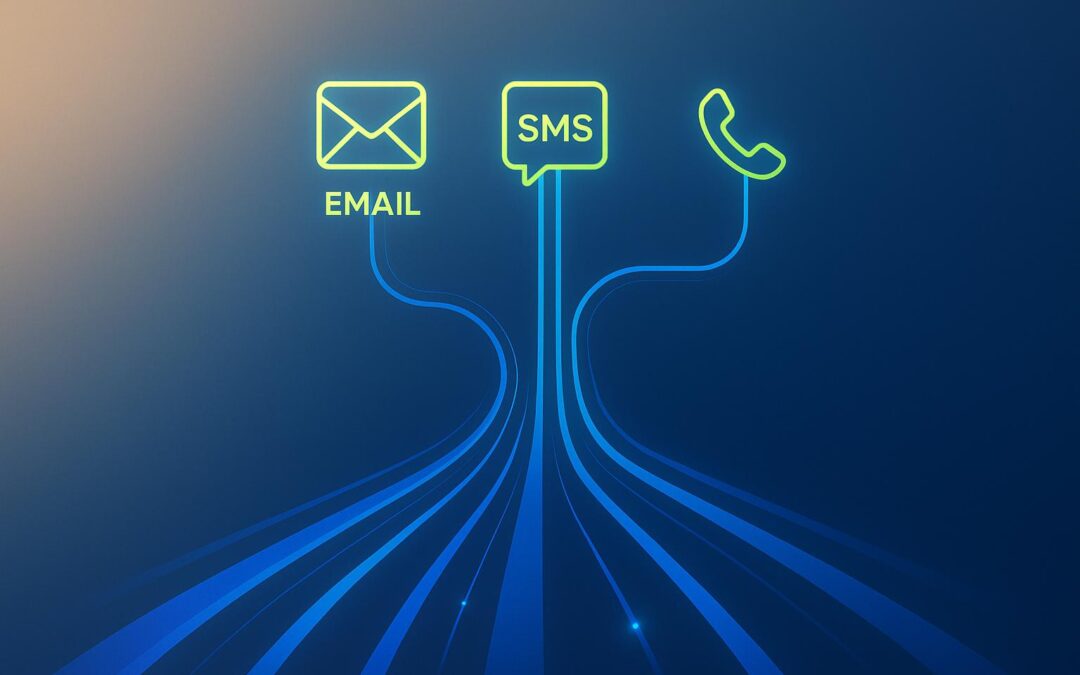
AI takes on the challenge of managing communication across email, SMS, and voice, creating a well-rounded strategy that connects with prospects where they’re most likely to respond. Instead of relying on just one method – like email – AI ensures a seamless multi-channel approach, increasing the likelihood of engagement by meeting people on their preferred platforms.
Traditional outreach methods often hit a wall when trying to scale beyond a small group of leads. AI eliminates that bottleneck by handling complex communication sequences. It adapts to each prospect’s responses, using engagement data to fine-tune when, where, and how messages are delivered for the best results.
Coordinating Outreach Across Multiple Channels
Think of AI as a conductor leading an orchestra, harmonizing SMS, email, and voice channels to deliver messages with precision. It doesn’t just blast out messages randomly; instead, it creates carefully planned sequences that feel both natural and well-timed.
For example, when a customer abandons their cart, the AI might start with a friendly email reminder. If there’s no response, it could follow up with an SMS – known for its high open rates. Still no engagement? The system might then initiate a voice call, delivering a personalized message that addresses potential concerns.
This approach also respects individual preferences. Some people respond better to texts, while others prefer emails or phone calls. By leveraging all three channels, AI ensures no opportunity is lost simply because a prospect favors one form of communication over another. Over time, the system learns which channels work best for specific audience segments, refining future campaigns for even better results.
This level of coordination allows businesses to deliver messages that feel personal without sacrificing scalability.
Creating Personalized Messages at Scale
AI doesn’t just coordinate outreach – it makes each message feel custom-made. One of the biggest misconceptions about automation is that it feels cold or generic. Modern AI flips that script by using customer data to craft messages that feel personal and relevant.
For instance, an e-commerce company trying to recover abandoned carts might send a message like: "Hi Sarah, we noticed you were eyeing those blue running shoes in size 8. They’re still available, and we’re offering a discount if you complete your order today!" Similarly, a service business might send a reminder with details like the provider’s name and scheduling options based on the customer’s past interactions.
AI also tailors the tone and content of messages to match where a customer is in their journey. Whether it’s a first-time visitor or a loyal client, the system adjusts its communication to fit the situation. And it does this on a massive scale – whether reaching out to 50 people or 50,000 – ensuring that every lead gets a personalized follow-up in real time.
Automating Timely Follow-Ups
Timing is everything, especially when it comes to recovering lost revenue. AI takes the guesswork out of follow-ups by analyzing response patterns and scheduling messages at the most effective times.
For example, after a customer abandons their cart, an email reminder might go out right away. If there’s no engagement, the system could schedule an SMS or voice follow-up at carefully chosen intervals. AI also knows when to back off – like when a customer unsubscribes or explicitly declines further communication – and adjusts the outreach strategy accordingly.
This level of automation solves a common problem with manual follow-ups: inconsistency. Sales teams might miss opportunities or prioritize leads unevenly, but AI ensures every prospect gets consistent attention. When a lead engages, the system can respond instantly or flag the conversation for human follow-up, making sure no opportunity slips through the cracks.
For businesses using tools like Unselfish AI, this automated timing spans SMS, email, and voice, constantly learning from campaign performance to improve engagement and recovery efforts. By optimizing follow-ups, AI ensures that businesses stay connected with their prospects at the right time, every time.
Key Applications of AI in Revenue Recovery
AI-driven revenue recovery delivers measurable results, especially in areas where traditional methods often fall short. It excels at reviving dormant leads, recovering abandoned shopping carts, and using voice AI to engage prospects through natural, conversational interactions. These applications align with a multi-channel outreach strategy, effectively addressing key revenue leaks.
Re-Engaging Dormant Leads
Every business has dormant leads – contacts who once showed interest but have since gone silent. Maybe they filled out a form months ago, joined a webinar, or scheduled a consultation that never materialized. These leads often represent untapped revenue sitting idle in your database.
AI steps in by pinpointing which leads are worth re-engaging and identifying the right time to reach out. Instead of sending generic messages to everyone, AI analyzes patterns to target leads most likely to respond. It considers factors like how long someone’s been inactive, their initial interests, and their preferred communication channels.
For example, service-based businesses can use AI to detect clients who haven’t booked an appointment in months and send personalized outreach. Messages are tailored to reference past interactions and address potential reasons for inactivity.
AI doesn’t just stop at sending one message – it continuously learns and adapts. If a lead doesn’t respond to an email, the system might try SMS next or adjust the tone of the message entirely. This constant refinement makes reactivation campaigns smarter, boosting their effectiveness over time. And because this approach integrates seamlessly with a broader multi-channel strategy, it ensures no opportunity is missed.
Recovering Abandoned Carts
Cart abandonment is a huge challenge for e-commerce businesses, costing an estimated $18 billion annually. But AI-powered solutions are changing the game, recovering 15-30% of abandoned carts compared to the 5-10% recovery rate of basic methods.
What sets AI apart is its ability to orchestrate personalized recovery campaigns across multiple channels. When a cart is abandoned, AI analyzes the customer’s browsing history, cart contents, and past purchases to craft an optimal recovery plan. For instance, the system might send an email reminder within the first hour, follow up with an SMS the next day, and even initiate a voice call – all timed to the customer’s behavior and time zone.
AI also handles incentives with precision. One major retailer reported recovering 22% of abandoned carts without offering any discounts, and another 18% with targeted, minimal discounts. The AI determines when to use scarcity messaging or social proof instead of discounts, protecting profit margins while still driving conversions.
Beyond recovering carts, AI uncovers new revenue opportunities. For example, an e-commerce fashion retailer found that 35% of recovered revenue came from personalized product recommendations, suggesting complementary items the customer had browsed but not added to their cart. This turns cart recovery into an upsell opportunity.
The financial impact is undeniable. AI-powered recovery programs deliver an ROI of 800-1,200%, far outpacing the 400-600% ROI of basic recovery efforts.
| Recovery Metric | Basic Recovery | AI-Powered Recovery |
|---|---|---|
| Overall Recovery Rate | 5-10% | 15-30% |
| Recovery with No Discount | 3-5% | 10-20% |
| Email Open Rate | 30-40% | 45-65% |
| Click-Through Rate | 10-15% | 20-35% |
| ROI on Recovery Program | 400-600% | 800-1,200% |
Platforms like Unselfish AI take this further by combining SMS, email, and voice outreach into coordinated recovery sequences. With a performance-based model, businesses only pay when a cart is successfully recovered, making it a low-risk, high-reward strategy.
Using Voice AI for Lead Engagement
Voice AI is transforming how businesses engage with leads and customers. Unlike traditional robocalls, which come across as impersonal, modern voice AI holds real conversations, handles objections, and even books appointments directly into your system.
This technology shines when re-engaging leads who haven’t responded to emails or texts. Some people simply prefer talking over reading, and voice AI meets them on their terms. It can be programmed to mimic your brand’s tone, ensuring consistent communication while scaling outreach effortlessly.
For service providers, automated voice calls for appointment reminders have been shown to reduce no-shows by 22.95%. Clinics using voice AI for follow-ups have reported up to a 40% decrease in missed appointments, directly boosting revenue.
Voice AI also handles complex interactions. It can answer common questions, address concerns about pricing or scheduling, and guide prospects through the booking process in real time. When an issue requires human input, the AI seamlessly transfers the conversation to your team, ensuring no opportunity slips through the cracks.
This technology works for both inbound and outbound scenarios. On the inbound side, voice AI ensures no lead is missed by answering calls 24/7. On the outbound side, it systematically follows up with dormant leads, no-shows, and prospects who expressed interest but didn’t convert.
Solutions like Unselfish AI make it easy to implement voice AI for lead qualification, appointment reminders, and database reactivation. The performance-based model ensures businesses only pay for successful outcomes, such as booked appointments or recovered revenue. By integrating voice AI into a multi-channel recovery framework, businesses can achieve consistent, high-quality engagement at scale.
Performance-Based AI: Pay Only for Results
The performance-based AI model redefines how businesses approach automation by ensuring you only pay for results that directly impact your bottom line, such as recovered revenue or confirmed appointments.
Traditional AI solutions often come with hefty upfront costs, recurring fees, and unpredictable expenses. This can be a major roadblock for businesses uncertain about the tangible benefits of the technology. Performance-based AI flips this script by tying costs directly to measurable outcomes. If the AI doesn’t deliver – whether it’s converting leads or recovering revenue – you don’t pay. Simple as that. This approach removes financial guesswork and provides a more accountable way to adopt automation.
How Pay-for-Results Works
Under this model, payment is directly linked to performance. For example, in revenue recovery campaigns, businesses may pay a percentage of the recovered revenue, ensuring fees align with the value delivered. The AI system meticulously tracks interactions across multiple channels, attributing each conversion to specific outreach actions, and calculates fees accordingly.
The pricing structure scales naturally with your results. As your revenue grows, so does the AI’s contribution – and the costs – without the need for new contracts or upgraded plans. Some systems even adjust fees based on Annual Recurring Revenue (ARR), aligning costs with your company’s growth trajectory.
Take Unselfish AI as an example. They offer services like database reactivation, cart abandonment recovery, and voice AI outreach without upfront fees. You’re charged only when the system successfully recovers revenue or books appointments, making it a risk-free way to embrace multi-channel automation.
Why the Performance-Based Model Works
The standout benefit here is cost efficiency. Unlike traditional automation tools that require a large initial investment, performance-based AI ensures every dollar spent is tied to tangible outcomes. For instance, in the accounts receivable sector, AI automation has delivered results equivalent to a full-time coordinator’s work at just a fraction of the cost. Some solutions have even recouped their costs within 30–60 days while saving teams over 40 hours per month.
This model is also inherently scalable. As your business grows, the AI adapts, and costs increase only in proportion to the results it delivers. Plus, by shifting the financial risk to the provider, you’re incentivizing continuous improvement in campaigns and strategies. If the AI doesn’t perform, you don’t pay – period.
For businesses focused on maximizing recovered revenue, this approach is a no-brainer. Platforms like Unselfish AI allow you to launch campaigns quickly, track results in real time, and pay only for outcomes that add real value. It’s automation that works as hard as you do, without the unnecessary expense.
sbb-itb-3bca853
Getting Started with AI-Driven Revenue Recovery
To kick off AI-driven revenue recovery, start by identifying where your revenue leaks are happening. With a clear plan, many businesses can launch campaigns in just a few days, achieving results without major disruptions. This approach ensures your AI efforts are laser-focused on your revenue recovery goals.
Identifying Your Revenue Recovery Needs
Before diving into AI, it’s crucial to pinpoint exactly where your revenue is slipping through the cracks. Map out your entire revenue cycle – from the moment a lead enters your system to the point where payment is received. Analyze every step, including manual processes, to uncover delays or errors that could be costing you money.
To measure the extent of the problem, calculate metrics like your Days Sales Outstanding (DSO) and track lost revenue from sources such as abandoned carts, unresponsive leads, and unpaid invoices. Don’t forget to account for the time spent on manual follow-ups. These figures will give you a clear starting point for assessing the impact of an AI-driven approach.
Once you’ve gathered the data, set measurable goals. Instead of vague objectives like "recover more revenue", aim for specific targets – such as reducing your DSO by a certain number of days, boosting the recovery rate of abandoned carts, or re-engaging a set number of dormant leads each month. By understanding where revenue is leaking, whether through overdue invoices, abandoned carts, or unresponsive leads, you can prioritize your AI efforts more effectively.
Setting Up an AI Solution
Collaborating with a performance-based provider like Unselfish AI allows you to launch campaigns quickly. These providers handle the heavy lifting – integrating with your CRM, setting up multi-channel communication, and fine-tuning the AI to reflect your brand’s voice.
For a smooth setup, grant secure access to your CRM or customer databases. This enables the AI to personalize outreach efficiently, ensuring every recovered lead directly impacts your bottom line.
Work closely with your provider to design an outreach strategy. Decide which channels – such as SMS, email, or voice – you’ll use, and determine the timing and frequency of messages. For example, you might set the system to send an immediate follow-up after a cart is abandoned, followed by additional outreach if the lead remains unresponsive. Establish clear criteria for escalating interactions to a human team when necessary.
It’s also essential to ensure compliance with regulations like TCPA guidelines for SMS and voice communications. Your AI solution should include built-in tools for managing opt-ins and opt-outs to stay within legal boundaries.
Tracking and Improving Campaign Performance
Once your campaign is live, monitoring its performance is crucial to achieving consistent results. A strong system should provide real-time dashboards that showcase metrics like delivery rates, response rates, conversion rates, and recovered revenue. Regularly reviewing this data can help you identify opportunities for improvement. For instance, if your messages are being opened but not converting, it may be time to tweak your messaging.
Think of AI implementation as an ongoing process. Use real-time data to experiment with different message variations, timing, and strategies to optimize your results over time.
Finally, schedule regular check-ins with your team and your AI provider. These reviews are an opportunity to discuss what’s working, what isn’t, and what changes could enhance performance. Staying engaged with the data ensures you’re making the most of AI-driven revenue recovery.
Conclusion: The Future of Revenue Recovery with AI
AI is reshaping how businesses approach revenue recovery by automating multi-channel outreach. Gone are the days of relying solely on manual follow-ups that consume time, strain resources, and leave opportunities untapped. Now, intelligent systems can send tailored messages across SMS, email, and voice, ensuring no prospect or customer is overlooked.
One of the standout advantages of performance-based AI solutions is that they remove financial risks. Instead of pouring money into expensive software or dedicating countless hours to manual efforts, businesses only pay when results are achieved. This approach keeps the focus firmly on what matters – recovering revenue.
AI excels at scaling personalized interactions. Whether you’re trying to re-engage 100 cold leads or reconnect with 10,000 customers who abandoned their carts, AI uses customer data to craft messages that resonate. This level of precision and scalability is virtually impossible with traditional manual methods, which demand significant time and effort for each interaction.
By addressing revenue gaps that manual processes simply can’t bridge, AI offers a smarter, more efficient solution. Beyond just recovering lost revenue, it allows your team to redirect their energy toward high-value activities, like closing deals and nurturing client relationships, instead of chasing unresponsive prospects.
Take Unselfish AI, for example. Solutions like this provide an efficient way forward for businesses dealing with revenue leaks. With minimal setup time and a pay-for-results model, these tools align costs directly with the revenue they help recover, making them both practical and cost-effective.
Revenue recovery no longer has to be a labor-intensive process. AI takes care of the heavy lifting – coordinating outreach across channels, personalizing communication at scale, and following up persistently. The results? Tangible improvements to your bottom line. If you’re ready to stop leaving money on the table, exploring AI-driven tools for revenue recovery is a smart next step. The technology is proven, accessible, and designed to deliver measurable outcomes without disrupting your operations or requiring upfront investment.
FAQs
How does AI choose the best way to reconnect with leads?
AI tools track real-time behavior and categorize leads based on their preferences and interactions. By examining patterns such as opened emails, responses to text messages, or engagement during calls, these systems pinpoint the best communication method to reconnect with each lead.
This personalized strategy increases the likelihood of re-engaging prospects, turning them into customers and boosting revenue recovery.
What are the advantages of using AI with a performance-based model for recovering lost revenue?
Using an AI model based on performance for revenue recovery comes with some clear advantages. One of the biggest perks? You only pay when you see actual, measurable results. This setup not only cuts down on upfront costs but also minimizes financial risks. Plus, it aligns your goals with those of the service provider, creating a partnership where both sides benefit.
AI also simplifies outreach across multiple channels – like SMS, email, and voice – to reconnect with leads and recover revenue that might have otherwise slipped through the cracks. By automating tasks such as reactivating dormant databases or addressing abandoned carts, it saves time and drives higher conversion rates. This means businesses can stay focused on scaling up while AI takes care of the more time-intensive processes with accuracy and efficiency.
How can businesses stay compliant with regulations when using AI for multi-channel outreach?
To stay within legal boundaries when using AI for multi-channel outreach, businesses need to put data privacy at the forefront. This means adhering to regulations like the General Data Protection Regulation (GDPR) or the California Consumer Privacy Act (CCPA). Key steps include obtaining explicit consent before reaching out to individuals, being transparent about how their data will be used, and offering clear options to opt out of communications.
On top of that, businesses should routinely review their outreach practices and AI tools to confirm they align with current legal and ethical standards. Working with AI providers that prioritize compliance, such as Unselfish AI, can make it easier to meet these requirements while fostering trust with their audience.