
AI transforms marketing by delivering tailored messages across platforms like email, SMS, and voice. Businesses using AI for personalization see 40% more revenue, 15–25% higher conversion rates, and better ROI. Customers expect this: 71% want personalized interactions, while 76% get frustrated by generic messaging.
Here’s how AI works:
- Data Integration: Combines browsing habits, purchase history, and real-time actions into unified customer profiles.
- Behavior Tracking: Monitors clicks, cart actions, and email engagement to predict customer needs.
- Dynamic Segmentation: Groups customers by behavior, not just demographics, for precise targeting.
- Channel Optimization: Chooses the best platform (email, SMS, or voice) and timing for each message.
Success depends on consolidating data, setting clear goals, and refining campaigns with performance metrics. AI doesn’t just send messages – it ensures they’re relevant, timely, and effective, boosting both customer satisfaction and business results.
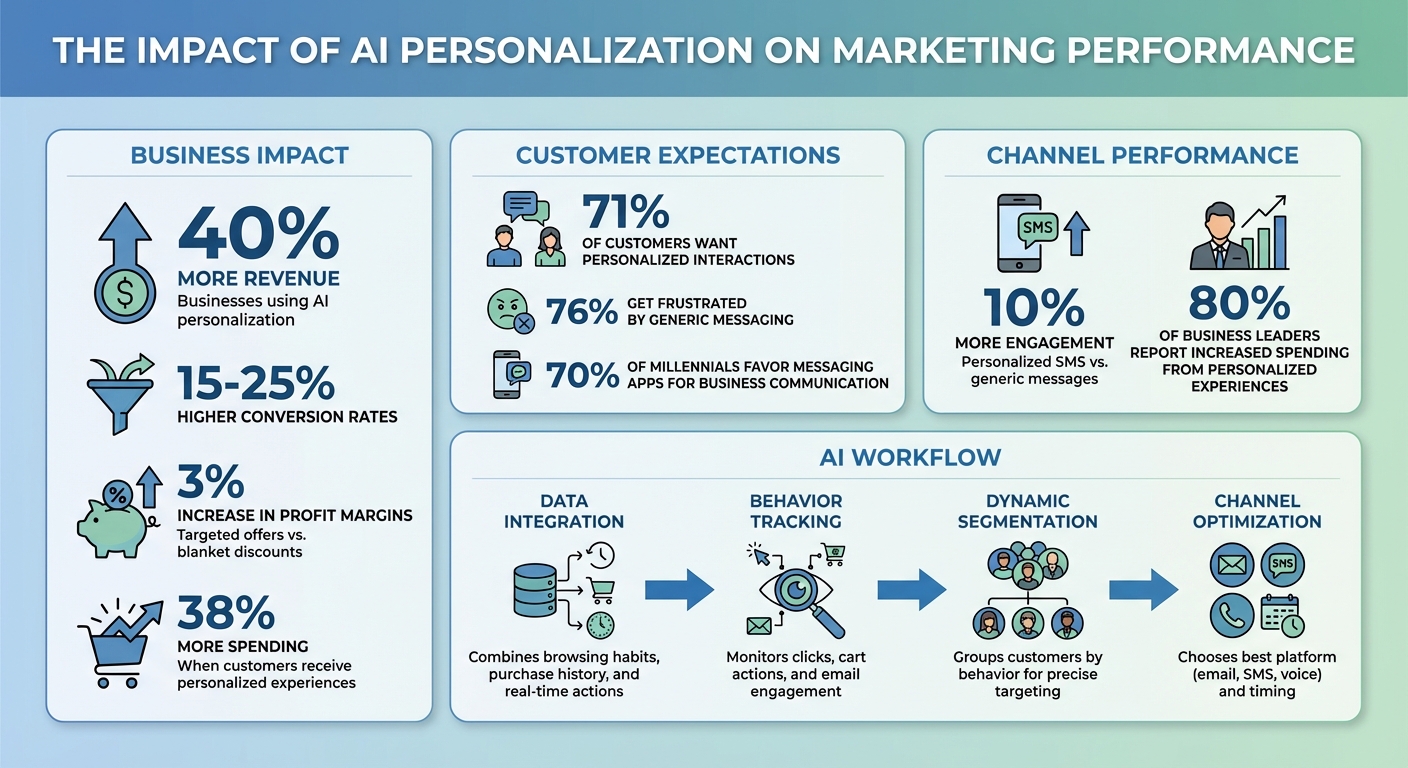
AI Personalization Impact: Key Statistics and ROI Metrics for Multi-Channel Marketing
Getting Ready for AI Personalization
Before diving into AI personalization, it’s crucial to lay a solid foundation. This involves consolidating customer data, monitoring behaviors, and leveraging predictive segmentation. Without these essentials, even the most advanced AI tools won’t deliver the desired results. Here’s how to prepare effectively.
Consolidating Customer Data
Customer data often exists in silos – spread across CRMs, e-commerce platforms, web analytics tools, mobile apps, and even in-store systems. These disconnected data sets make it hard to get a full picture of your customers. AI personalization thrives on unified customer profiles, which bring together data like behaviors, preferences, and purchase history. Tools such as Customer Data Platforms (CDPs) are invaluable here, helping to integrate diverse data sources while ensuring compliance with regulations like GDPR. Start by cataloging all customer touchpoints and identifying any gaps in your data.
"We’ve really had to bridge that gap between online and offline and offer new omni-experiences. […] Introducing a loyalty program [allows] us to merge those data points and build that rich picture of our customer from an omni-perspective, and use that data to gather insights and really understand our customer and then use that to personalize experiences."
– SAP Emarsys
Once you have a unified profile, you can begin tracking real-time interactions more effectively.
Tracking Customer Actions and Behaviors
AI relies on real-time customer actions, not just static demographic data. This means keeping tabs on behaviors like clicks, hovers, cart activity, purchases, email engagement, and even social media interactions. Both immediate actions and long-term patterns contribute to AI’s ability to predict customer intent.
For instance, imagine a customer abandons their cart at 9:00 PM on a Tuesday, then opens a follow-up email the next morning but doesn’t click through. AI can analyze this behavior to decide whether the next step should be an SMS reminder, a phone call, or another email – and determine the best time to send it for maximum impact.
Segmenting Audiences with Predictive Models
Traditional segmentation relies on static demographics, but AI-driven segmentation uses evolving behaviors to create dynamic micro-segments. Predictive analytics plays a key role here, estimating the likelihood of actions like making a purchase, abandoning a cart, or churning based on past behaviors.
Take Starbucks, for example. Their predictive algorithms recommend drinks based on factors like purchase history, time of day, and even the weather. These insights also help with inventory planning, ensuring popular items are in stock when customers are most likely to buy.
For businesses adopting AI personalization, predictive scoring methods are invaluable. They help assess how likely a customer is to engage with offers or take specific actions. Segment customers by their lifecycle stage – whether they’re new, at risk of churning, or in need of re-engagement. For example, a North American retailer shifted from blanket discounts to targeted offers, increasing profit margins by 3% and generating significant revenue within a year.
Building AI-Personalized Multi-Channel Campaigns
Once you’ve organized your data and identified your audience segments, it’s time to create campaigns that cater to individual customer preferences. The idea is simple: connect your goals to the right audiences and channels, then let AI take care of the personalization. Start by defining your objectives and choosing the channels that align with them.
Setting Campaign Goals and Target Audiences
Your campaign goals could range from recovering abandoned carts to increasing order value or re-engaging inactive leads. Each goal comes with its own set of metrics and target audiences. For example, if you’re tackling cart abandonment, focus on customers who added items to their cart within the last 24 hours but didn’t check out. If you’re looking to reactivate your database, aim for contacts who haven’t interacted in over 90 days. Make sure your objectives align with your overall business goals and set benchmarks based on your past performance.
Think about where each audience segment falls in the customer lifecycle. New prospects might benefit from educational content, while at-risk customers could respond better to exclusive discounts or personalized outreach. It’s worth the effort – 80% of business leaders say personalized experiences lead to customers spending 38% more on average.
Choosing the Right Channel for Each Message
AI can analyze customer data to predict the best channel for reaching each individual. Some people respond to morning emails, while others prefer evening SMS or even a personal phone call for bigger decisions.
- Email works well for sharing detailed product information or offers that need some explanation.
- SMS is perfect for time-sensitive messages, like reminding someone about an abandoned cart or confirming an appointment, thanks to its high open rates.
- Voice calls bring a personal touch, especially for high-value leads or retention efforts.
AI can also determine the best time to send each message by analyzing past behavior patterns. Once you’ve identified the right channels, set up rules to customize each message based on customer actions.
Setting Up AI Personalization Rules
Start with simple rules, such as sending a discount code after a cart is abandoned, and gradually move toward more advanced, real-time personalization. The goal is to predict customer needs and adjust content dynamically without coming across as intrusive.
It’s important to respect customer preferences and comply with regulations like GDPR and CCPA. For instance, if a customer opts out of SMS communication, your AI can automatically switch to email or pause outreach entirely. Regularly test and refine your rules to improve performance. As customer preferences evolve, update your AI models to stay relevant.
Personalization Methods for Each Channel
Crafting messages that align with the unique rhythm of each channel – whether it’s a detailed email, a concise SMS, or a personal call – can make all the difference in connecting with your audience.
Email Personalization
AI has revolutionized email marketing by analyzing customer behavior across platforms like websites, apps, social media, and previous email interactions. This data helps build detailed profiles, allowing businesses to identify valuable prospects and fine-tune their targeting efforts. AI takes personalization a step further by testing different creative elements – such as subject lines, images, and calls to action – to determine what resonates most with specific individuals or audience segments.
For example, someone who abandoned their shopping cart might receive an email highlighting the items they left behind, while a loyal customer might be rewarded with exclusive early access to new products. AI also optimizes email timing by predicting when recipients are most likely to open and engage with messages.
SMS Personalization
With 70% of millennials favoring messaging apps for business communication, SMS has become a key channel for personalized outreach. AI enables SMS campaigns to be dynamic and modular, tailoring content in real time based on customer behavior and preferences.
A European telecom company demonstrated this by testing roughly 2,000 SMS actions over several months while ensuring messages remained concise and relevant. The result? Customers who received personalized messages engaged 10% more frequently than those who received generic ones. AI can even predict whether a recipient is more likely to respond to a discount offer or educational content, ensuring the right message lands at the right time.
Voice and Call Personalization
Voice outreach adds another layer to a cohesive, multi-channel strategy. AI enhances call campaigns by tailoring scripts based on customer profiles, lead scores, and previous interactions. For instance, calls to high-value leads may take on a more professional and warm tone, while cold outreach focuses on direct, value-driven messaging.
AI-powered voice assistants can personalize interactions in two ways:
- Implicit personalization: Adjusting greetings for new or returning users and optimizing for the device being used.
- Explicit personalization: Using authenticated data like purchase history, cart abandonment details, and customer lifetime value.
AI also customizes call frequency, retry attempts, and scheduling to align with customer availability. For example, B2B calls might be scheduled during business hours, while consumer-focused calls could be timed for the evening. Based on call outcomes, AI determines the next step – whether that’s a follow-up call, an email, or involving a human representative.
sbb-itb-3bca853
Measuring and Improving AI Campaigns
To understand how well your AI campaigns are performing, focus on key business metrics like conversion rates, recovered revenue, click-through rates, and open rates. These metrics provide a clear picture of your campaign’s impact. For instance, organizations leveraging AI-driven personalization often achieve 15-25% increases in conversion rates. However, consistent tracking is essential to determine whether you’re hitting those benchmarks. These numbers form the foundation of a results-oriented measurement strategy.
Key Metrics to Track
Your dashboard is your best friend when it comes to tracking customer engagement and conversions. Monitor how customers interact at different stages of their journey – whether it’s email opens, SMS responses, or completed purchases. For campaigns aimed at recovering lost sales, recovered revenue should be your guiding metric. If you’re running multi-channel campaigns, keep an eye on which channel ultimately drives the conversion and how many touchpoints it takes to close the deal.
Running A/B Tests with AI
Once you’ve identified your key metrics, use A/B testing to fine-tune your campaigns. For example, a North American retailer moved away from generic discounts to personalized offers and tested their AI models with A/B experiments over two-week periods. By experimenting with different promotional messages – primarily through email – they achieved a 3% increase in annualized margins after three months. To replicate such success, test one variable at a time, such as subject lines, discount percentages, or the order of communication channels. Compare personalized sequences against control groups to validate additional conversions.
Improving AI Models with Performance Data
AI thrives on data, and the more it learns from performance metrics, the better it gets. Take the example of a European telecom company that built AI models to predict customer responses to 2,000 different actions. By refining their messaging, they achieved a 10% boost in engagement. To maintain this momentum, set up regular optimization cycles: review how individual channels perform on a weekly basis, analyze cross-channel patterns monthly, and assess your overall strategy quarterly.
As Salesforce puts it, "AI continuously refines marketing campaigns by learning from performance metrics, allowing advertisers to adapt strategies dynamically and achieve better results with greater efficiency". This constant cycle of learning and adapting enables AI to predict the best message, offer, and timing for each customer, reinforcing its ability to deliver highly personalized and effective multi-channel campaigns.
Conclusion
AI-driven multi-channel personalization is changing the way businesses recover lost revenue and convert leads. By analyzing extensive customer data, AI turns missed opportunities into reliable income streams.
It doesn’t stop there – AI can spot accounts at risk and address potential issues before customers disengage.
To make the most of these capabilities, businesses need scalable infrastructure. Unselfish AI offers a results-focused solution for multi-channel outreach. They specialize in database reactivation, cart abandonment recovery, and voice AI campaigns across SMS, email, and voice platforms. The best part? Their pay-for-results model ensures you only pay when the AI delivers – whether that’s recovered revenue or scheduled calls – helping you maximize ROI.
AI also gets smarter with time. By learning from performance data, it fine-tunes its predictions and delivers more accurate messaging. Whether it’s re-engaging dormant leads or converting fresh prospects, this iterative process allows outreach efforts to grow without losing that personal touch. And as the technology advances, its potential to deliver results only gets stronger.
FAQs
How does AI choose the right channel and time for personalized messages?
AI uses customer data – like past actions, preferences, and engagement trends – to figure out the best channel and timing for personalized messages. By leveraging predictive analytics and real-time insights, it pinpoints when and where customers are most likely to engage.
This means messages are delivered through the ideal platform – whether it’s email, SMS, or voice – at just the right time. By aligning outreach with individual behavior, AI makes communication more relevant, helping to capture attention and drive better response rates.
What steps should businesses take to prepare for AI-driven personalization?
To get ready for AI-driven personalization, businesses should begin by establishing specific, measurable goals and identifying the key performance indicators (KPIs) that will track success. Once that foundation is set, the next step is to collect and consolidate all relevant customer data. This can come from multiple sources – CRM systems, analytics platforms, and marketing tools – to build a complete picture of your audience.
Equally important is creating a consistent messaging framework that aligns with your brand’s identity. Make sure your brand guidelines are clear and well-documented so that your messaging stays cohesive across all channels. Lastly, select AI-powered tools that fit your objectives and work seamlessly with your current systems. These tools will help you deliver personalized, multi-channel communication effectively.
How does AI boost ROI in multi-channel marketing campaigns?
AI helps improve the return on investment (ROI) for multi-channel marketing campaigns by enabling deeply personalized communication across platforms like SMS, email, and voice. It leverages data insights to craft messages that align with individual preferences, making sure the right audience gets the right message at the perfect moment.
On top of that, AI takes over repetitive tasks like content creation and scheduling, cutting down on time and costs. By fine-tuning the choice of channels and timing, businesses can see stronger engagement, higher conversion rates, and better overall results from their campaigns.