

AI lead enrichment automates the process of improving lead data by filling in missing details like contact information, company data, and behavioral insights. Using tools like machine learning (ML) and natural language processing (NLP), it transforms incomplete records into detailed profiles that help sales teams target the right prospects faster and more effectively.
Key Benefits:
- Saves Time: Eliminates manual research by automating data collection and validation.
- Improves Accuracy: Ensures up-to-date and reliable lead data by cross-referencing multiple sources.
- Boosts Conversions: Enriched leads result in better targeting, personalized outreach, and higher success rates.
How It Works:
- Data Collection: AI gathers basic lead information from sources like web forms, CRMs, and social media.
- Enrichment: Additional data (e.g., job titles, company size, revenue) is added using tools like LinkedIn, Crunchbase, and public records.
- Verification: AI validates the data for accuracy and removes duplicates.
- Scoring & Routing: Leads are ranked based on likelihood to convert and routed to the right sales reps.
Why It Matters:
Incomplete or outdated lead data wastes time and resources. AI lead enrichment solves this by providing detailed, actionable insights in seconds, helping sales teams focus on high-priority prospects and close deals faster.
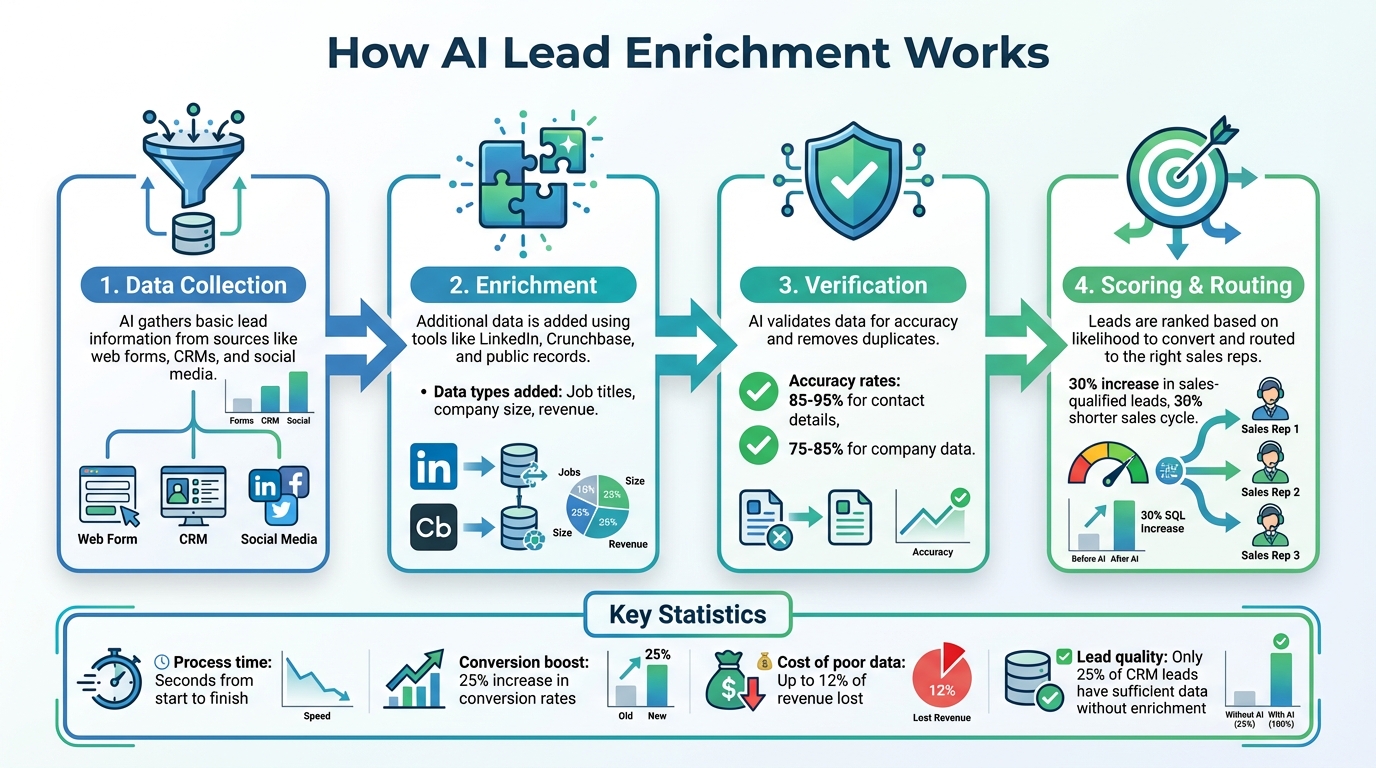
AI Lead Enrichment Process: 4-Step Workflow from Data Collection to Lead Routing
Core Components of AI Lead Enrichment
Types of Data Used in Enrichment
AI lead enrichment transforms basic lead details into detailed profiles. This typically includes contact information like phone numbers, verified email addresses, and social media profiles (e.g., LinkedIn, Twitter). Another key component is firmographic data, which provides insights about the company. This can range from industry and company size to revenue estimates (in USD), location, founding date, and organizational structure – adding depth to each lead profile.
Such data comes from a wide variety of sources, ensuring a rich and detailed picture of each lead.
Where AI Gets Enrichment Data
AI systems pull enrichment data from a range of sources, including databases, social media platforms, company websites, news outlets, and public records. For example, LinkedIn offers job titles and career histories, while internal CRM systems provide details about previous interactions and purchase behaviors. Validation APIs play a crucial role in ensuring the accuracy of email addresses and phone numbers. Additionally, public web sources like press releases and industry news provide valuable context, such as signals of buying intent.
Data Quality and Preparation
Once data is gathered, keeping it clean and standardized is critical for effective AI lead enrichment. Poor-quality data – such as incomplete entries, duplicates, or outdated information – can lead to unreliable insights, missed opportunities, and flawed forecasts. AI-driven tools help by automating data validation and cross-checking information from multiple sources, ensuring profiles are continuously updated in real-time.
Preparation involves tasks like removing duplicates, standardizing formats (e.g., ZIP codes, dates in MM/DD/YYYY format, and currency in USD), and assigning clean identifiers. These steps ensure the enriched data integrates seamlessly with existing systems, supporting accurate lead scoring and efficient routing.
How AI Lead Enrichment Works
Lead Ingestion and Normalization
AI systems kick off the process by gathering lead data from various sources like web forms, e-commerce checkouts, chat interactions, and CRM imports. These initial entries usually include basic details such as a name, email address, company, or phone number. The AI then standardizes this information, converting it into a uniform format. This step, known as normalization, ensures the data is consistent and ready for the next stages. Data connectors play a crucial role here, enabling smooth and seamless transfer of information across platforms.
This structured approach sets the stage for immediate, real-time enrichment.
Real-Time Data Aggregation and Enrichment
Once normalized, the AI pulls in additional data from a wide range of sources, including LinkedIn profiles, Crunchbase, SEC filings, company websites, press releases, job postings, and intent data providers. Using machine learning, it identifies patterns and conversion signals based on historical and behavioral trends. Natural Language Processing (NLP) also steps in to extract insights from unstructured data like email conversations, sales call transcripts, and social media activity. This enables the system to quickly create detailed lead profiles, adding valuable insights such as job titles, company revenue (in USD), funding stages, and even specific signals like leadership changes or ongoing product research.
Once the enrichment process is complete, the data is verified and prioritized for immediate action.
Verification, Scoring, and Routing
After enriching the data, AI systems validate it by cross-referencing key details – like email addresses, job titles, company revenue, and organizational structures – to ensure accuracy and reliability. The next step involves predictive scoring, where leads are ranked based on factors such as engagement patterns, firmographics, technographics, competitor activity, and past conversion data. This scoring process can significantly improve the quality of sales-qualified leads, with studies showing a 30% increase in effectiveness.
High-priority leads are then routed to the most appropriate sales representatives. This assignment is based on various criteria, including location, industry, account size, and how well the lead matches the Ideal Customer Profile (ICP). By automating these workflows, AI not only speeds up outreach but also shortens the sales cycle by as much as 30%. From start to finish, this entire process – data ingestion to lead routing – typically happens in mere seconds. AI enrichment achieves impressive accuracy rates, with 85-95% for basic contact details and 75-85% for more intricate company data.
Setting Up an AI Lead Enrichment Workflow
Define Your Goals and Data Requirements
Start by identifying your Ideal Customer Profile (ICP) using insights from your top-performing customers. Dive into your CRM data and lead scoring analytics to uncover patterns tied to revenue, lifetime value, product usage, and retention rates. Why is this important? Companies that implement effective lead enrichment strategies often see conversion rates increase by 25% and deals close 30% faster.
Next, audit your current lead data. Surprisingly, only 25% of sales leads in a typical CRM contain enough details to support meaningful conversations. Focus on filling in the gaps with data that directly influences your sales decisions – like job titles, company revenue (in USD), technology stacks, or buying signals. If speeding up your sales cycle is the goal, prioritize intent data to identify prospects who are ready to buy.
Clean and standardize your data to avoid costly mistakes. Poor-quality or incomplete information can cost businesses up to 12% of their revenue, while accurate data can boost sales by 5-10%. To maintain high-quality data, set up automated validation systems and ensure consistent formatting across all records.
Connect Your Data Sources and Tools
Before diving in, take stock of your current tools. Review your sales, marketing, and CRM platforms to identify integration opportunities and any technical challenges. Pay close attention to how data fields like company names, email addresses, phone numbers, and firmographics are formatted, ensuring consistency between your enrichment tool and CRM.
Integrate key data sources such as your internal databases, social profiles, email platforms, and analytics tools. Keep your data up-to-date with regular syncs and set alerts to catch any integration issues. Decide whether you need real-time enrichment or batch processing based on your business needs, and plan for API rate limits, error handling, and compliance with privacy laws.
Once connected, track metrics like enrichment coverage rates, data accuracy, cost per enriched lead, and the impact on sales outcomes such as response and conversion rates. With your data ecosystem in place, you’re ready to automate outreach.
Configure Automation and Multi-Channel Outreach
Use enriched data to automate lead scoring and routing. Set up triggers based on factors like company size, technology stack, engagement level, territory, product interest, or customer status to ensure high-priority leads are quickly assigned to the right team members. This can make a big difference – sales conversions can increase by 391% when leads receive follow-up within a minute of their inquiry.
Define specific trigger events, such as the creation of a new lead or reaching a scoring threshold, to kick off automation. Leverage AI tools to pull data from multiple sources, update lead records in real-time, and score leads based on their enriched profiles. Businesses using automated lead scoring report a 51% boost in lead-to-deal conversion rates.
Build multi-channel outreach campaigns that take advantage of your enriched data for personalized follow-ups via SMS, email, and voice. Personalization matters – 77% of consumers prefer brands that offer tailored experiences. Companies using enriched data in their marketing efforts generate up to 2.9 times more revenue while cutting costs by 1.5 times. For revenue recovery, platforms like Unselfish AI can integrate enriched lead data into automated campaigns, handling tasks like database reactivation, cart abandonment recovery, and voice AI outreach. Their pay-for-results model ensures you only pay for recovered revenue or booked calls.
With these steps in place, you’ll be ready to measure and refine your AI lead enrichment workflow to keep improving sales performance.
sbb-itb-3bca853
Measuring and Improving AI Lead Enrichment
Metrics to Track
To truly understand the impact of AI on lead enrichment, it’s essential to focus on the right metrics. Start by monitoring lead qualification accuracy and conversion rates. AI-driven lead qualification has been shown to boost conversions by up to 30% and shorten sales cycles by 20-30%. These numbers highlight the efficiency gains AI can bring to your sales process.
Another key area to watch is response times. Research shows that delays longer than five minutes can drastically reduce sales success, with the chances dropping even further as delays increase. Additionally, track engagement rates by channel to pinpoint which platforms – email, SMS, or voice – yield the best results. For instance, emails with personalized subject lines see a 26% higher open rate, and segmented campaigns have driven a staggering 760% increase in email revenue.
Don’t overlook cost per qualified lead (CPQL). Measuring CPQL in USD provides a clearer picture of your actual return on investment, beyond just the cost of acquiring any lead. Also, keep an eye on conversion rates from lead to paying customer and the length of your sales cycle. Businesses using AI for sales have reported up to 15% higher revenue and 10-20% better sales ROI. These metrics will help you fine-tune your enrichment strategies and maximize your outcomes.
Refining Enrichment Rules and Models
AI models thrive on data and feedback, learning and improving over time by analyzing historical trends and real-time results. To keep your system sharp, regularly update your qualification criteria and predictive scoring models. Pay attention to which data fields – like company revenue or technology stacks – consistently correlate with successful conversions, and prioritize those in your enrichment workflow.
Tailor your enrichment rules to align with your business goals and audience. For example, if certain firmographic details are repeatedly linked to closed deals, make them a focal point in your lead enrichment process. Sales team feedback is invaluable here – use it to refine your approach and enhance both lead quality and system performance.
Once your rules are updated, validate them with thorough testing to ensure they deliver the desired results.
A/B Testing Enriched vs. Non-Enriched Leads
The best way to measure the effectiveness of your enrichment efforts is through A/B testing. Compare enriched leads against non-enriched ones in controlled experiments to assess their impact. Start small with a pilot program involving 1-10 users over 2-3 months to gather actionable insights before scaling up. Studies show that enriched leads convert to customers 2-3 times more often than those with only basic contact details.
Define clear metrics for your comparisons, such as conversion rates, data accuracy, time efficiency, revenue impact, and engagement rates by channel. Test in phases to avoid overwhelming your system and ensure meaningful results. Keep in mind that 70% of businesses prioritize lead quality over quantity, so focus on how enrichment enhances the quality of your leads rather than just increasing volume.
Organizations that excel in lead enrichment are 2.5 times more likely to achieve significant improvements in sales performance. Use the insights from your A/B tests to refine workflows and algorithms, continuously improving your strategies based on data-driven results.
Conclusion
Benefits of AI Lead Enrichment
AI lead enrichment transforms lead management in the U.S. by automating data updates and allowing sales teams to focus on what they do best – selling. With enriched profiles delivered in seconds, sales reps can jump into informed outreach without delay.
Equally important is the improvement in data quality. By cross-checking multiple sources, AI identifies and corrects outdated information, duplicates, and inconsistencies, ensuring your team works with accurate, current prospect data. This precision enables highly personalized outreach through email, SMS, and voice channels, which naturally leads to better response rates and higher engagement. With real-time intent signals and detailed firmographics, your sales team can craft messages that resonate with prospects at just the right moment.
How Unselfish AI Supports Enrichment and Automation
Unselfish AI takes these benefits a step further with tools designed to optimize the enrichment process. Operating on a performance-based model, it ensures you only pay for tangible results, such as recovered revenue or scheduled calls. The platform automates the collection, validation, and enhancement of lead data from various sources in real time. By leveraging machine learning and natural language processing, it fills in missing details, standardizes information, and provides predictive lead scoring.
For database reactivation, Unselfish AI keeps lead data fresh and identifies cold leads that now show signs of interest. Its multi-channel outreach – spanning voice AI, SMS, and email – delivers highly personalized interactions across every touchpoint. Plus, seamless integration with your existing CRM and sales tools enables automated workflows for lead scoring, routing, and personalized triggers, speeding up your sales process and increasing conversion rates.
Final Thoughts
With its ability to aggregate real-time data and automate lead scoring, AI lead enrichment is more than just a tool – it’s a game-changer for scalable and efficient sales operations in today’s competitive landscape. By equipping sales teams with precise, enriched data, it empowers them to connect with prospects effectively, shorten sales cycles, and drive revenue growth.
FAQs
How does AI lead enrichment boost sales conversions?
AI lead enrichment helps businesses enhance sales conversions by providing precise, current, and comprehensive details about potential customers. This enables companies to fine-tune their audience targeting, craft tailored outreach strategies, and quickly pinpoint leads with the most potential.
Armed with enriched data, sales teams can connect with prospects more effectively, reduce the time it takes to close deals, and concentrate their energy on the opportunities that truly count. The outcome? Better engagement, streamlined processes, and a boost in revenue.
What data is essential for successful AI-driven lead enrichment?
When it comes to AI-powered lead enrichment, a few types of data play a crucial role in making the process effective. First, there are contact details – things like email addresses and phone numbers – that form the foundation of any outreach. Then, there’s company information, which includes specifics like the industry they operate in, company size, and revenue figures. Adding social media profiles to the mix helps provide a deeper understanding of the lead’s professional presence and interests.
Beyond these basics, behavioral data takes the analysis further. This includes tracking how leads interact with your website, emails, or other digital touchpoints. Coupled with intent signals – indicators of buying interest or readiness – these insights allow AI to piece together a more complete profile of each lead. The result? Tailored engagement strategies that resonate with individual prospects.
How does AI improve the accuracy of lead enrichment data?
AI improves the precision of lead enrichment data by leveraging advanced machine learning algorithms. These algorithms analyze and cross-check information from various trusted sources, identifying and fixing errors, removing outdated data, and eliminating duplicates. The result is a cleaner, more reliable dataset.
By studying past trends and consistently refining its methods, AI ensures that enriched lead data stays accurate and relevant. This not only supports better decision-making but also enhances the impact of outreach efforts for businesses.