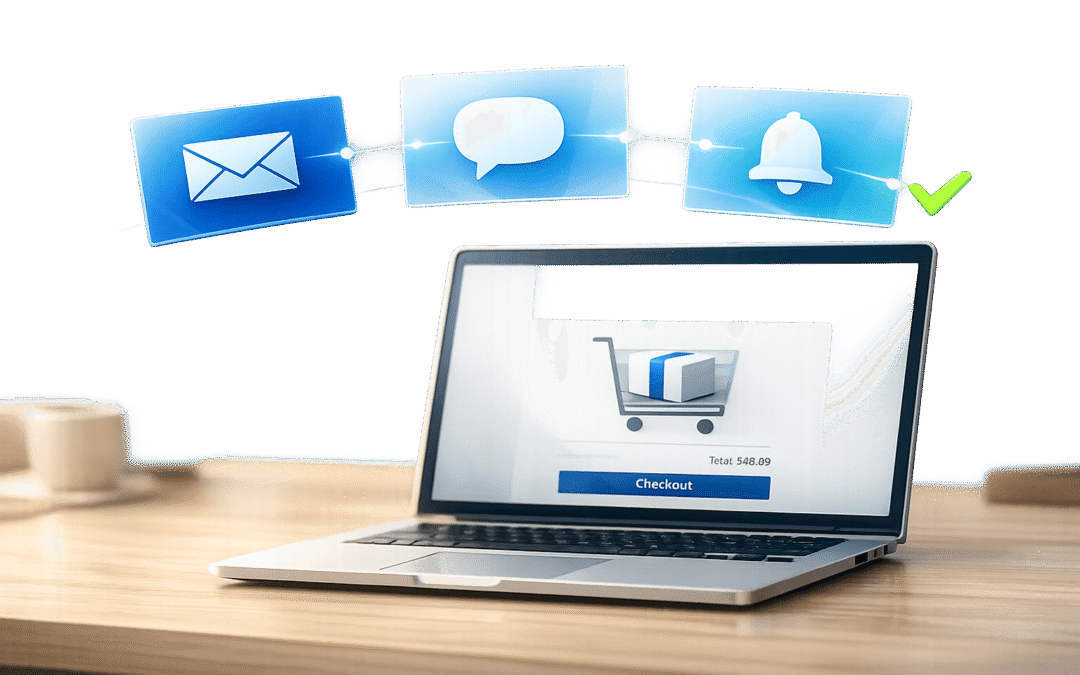
E-commerce businesses lose billions every year due to abandoned carts – $18 billion in the U.S. alone. But AI-powered drip campaigns are proving to be a powerful solution, recovering 45-56% of lost sales compared to the 15% average from traditional email follow-ups. These campaigns use real-time behavioral data to send personalized messages across email, SMS, and other channels, addressing customer concerns like unexpected costs or complex checkout processes.
Key Takeaways:
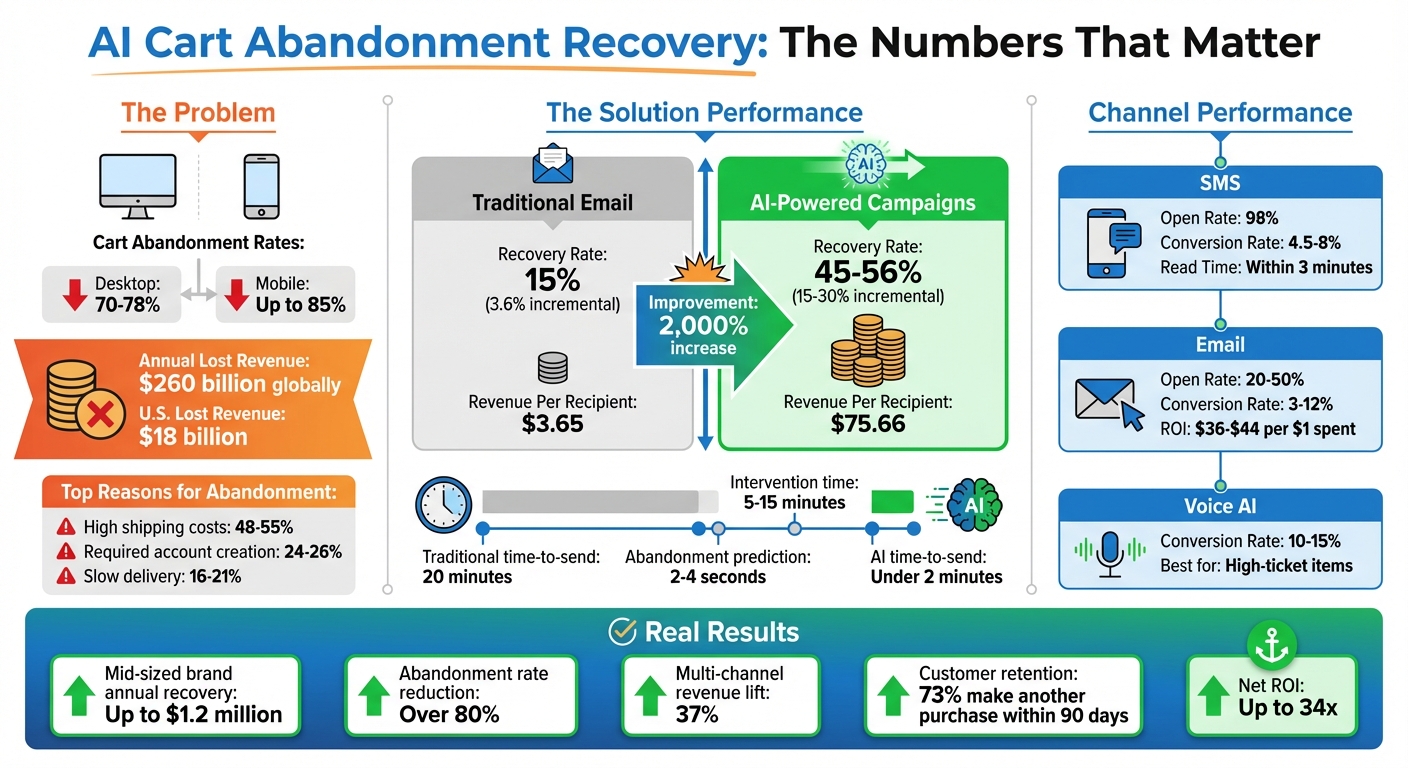
- Cart abandonment rates: 70-78% on average; up to 85% on mobile.
- Why customers abandon carts: High shipping costs (48-55%), required account creation (24-26%), and slow delivery (16-21%).
- AI advantages: Predicts abandonment in 2-4 seconds, customizes responses, and recovers $75.66 per recipient on average.
- Multi-channel strategy: SMS boasts a 98% open rate, while email and voice AI add depth to recovery efforts.
- Results: AI campaigns recover up to $1.2 million annually for mid-sized brands and reduce abandonment rates by over 80%.
AI drip campaigns are transforming cart recovery by combining speed, personalization, and multi-channel outreach to reclaim lost revenue while improving customer retention.
AI Cart Abandonment Recovery Statistics and ROI Comparison
Setting Up AI-Driven Cart Recovery Campaigns
You can establish an AI-powered cart recovery system in three steps: gather the necessary data, set up smart triggers, and define success metrics. Most e-commerce platforms already collect the data you need – it’s just a matter of connecting the dots. Let’s break down the essentials your AI system requires.
Required Data and Tools
Your AI system relies on two key data types: cart event tracking and customer contact information. Critical cart events include actions like "Cart Updated" (adding or removing items) and "Checkout Started/Updated", which capture essential product details such as IDs, names, prices, image URLs, and variants.
Advanced AI takes it a step further by analyzing real-time behavioral signals – like mouse speed, scrolling patterns, tab-switching, and typing pauses – to predict when a customer is about to abandon their cart, often within 2–4 seconds. On mobile, similar indicators, such as app-switching, can signal an imminent exit.
You’ll also need customer profile data, like purchase history, lifetime value potential, and price sensitivity scores. This helps the AI decide whether a simple reminder is enough or if an incentive is needed. Make sure you secure explicit consent for SMS and email outreach to comply with regulations like TCPA and GDPR. Collecting contact information early in the checkout process ensures compliance and improves outreach effectiveness.
For integration, connect your e-commerce platform (e.g., Shopify or WooCommerce) with your CRM and a CDP (Customer Data Platform). This setup synchronizes data across channels and prevents over-marketing, such as suppressing retargeting ads once a recovery email is opened.
Defining Triggers and Customer Segments
Traditional cart recovery systems often send reminders after a set time delay, like one hour. AI, however, can detect exit intent and intervene in real-time, which has been shown to outperform rule-based systems by 2–3 times.
Segmenting your audience is critical. For instance:
- High-value carts (over $200) may warrant personalized SMS follow-ups.
- New visitors might respond better to trust-building content, such as customer reviews or guarantees.
- Repeat customers often engage more with loyalty rewards or familiar messaging.
A great example is Allbirds, which implemented this strategy in 2025–2026. By using dynamic email campaigns through Klaviyo and AI chatbots from Tidio, they segmented customers and optimized send times. This approach led to a 26% increase in their cart recovery rate, reducing the time-to-send from 20 minutes to under 2 minutes.
A common drip campaign cadence follows a 1-24-72 hour sequence:
- 1-hour mark: Send a reminder without a discount.
- 24-hour mark: Follow up with a social proof email.
- 72-hour mark: Offer a final incentive.
To avoid "discount training", reserve discounts for price-sensitive customers or use them as a last resort. With these triggers and segments in place, defining clear goals and metrics ensures your campaign stays on track.
Setting Campaign Goals and Metrics
Instead of focusing on total recovered revenue, prioritize incremental revenue – sales that happen solely due to your recovery efforts. Set aside 10–20% of abandoned carts as a control group to measure true incremental conversion rates.
Here are some benchmarks to aim for:
- Incremental recovery rate: 8–15%.
- Discount attachment rate: Below 30%.
- Revenue per recovery email: $3–8.
- Cost per recovered cart: $0.50–3.00.
- Cannibalization rate: 20–40% (representing purchases that might have occurred organically).
- Unsubscribe rate: Less than 0.5%.
- Overall recovery rate: 25–35% (with top programs reaching 45–55%).
Run quarterly holdout tests to adjust for changes in consumer behavior. Multi-channel attribution is also vital. For example, SMS recovery messages typically achieve open rates of 98% and conversion rates of 4.5–8%, while email open rates range from 20–50%, with conversion rates between 3–12%. When executed effectively, a recovery program can deliver up to a 34x net ROI, driving revenue and strengthening your bottom line.
sbb-itb-3bca853
Building Your AI Drip Campaign Sequence
Once you’ve set up your data and triggers, it’s time to create a message sequence that balances timing, personalization, and channel selection. The goal? To reach customers at just the right moment. AI takes over the guesswork by analyzing individual behavior and fine-tuning every touchpoint in real time.
Creating the Message Timeline
The 1-24-72 hour cadence provides a starting framework, but AI takes it further by analyzing user behavior, like mouse speed or scroll depth, to predict when abandonment is likely – sometimes within just 2–4 seconds. For instance, if a user scrolls rapidly upward on mobile (indicating a back gesture), AI can instantly trigger an exit-intent offer.
Timing adjustments are also context-sensitive. For example, if someone abandons their cart late at night (after 10 PM), AI might delay the first message until the next morning when engagement is higher. Repeat buyers with shorter purchase cycles may see condensed 24-hour sequences to avoid overwhelming them. Marina Carroll, Head of CRM Strategy at New Standard Co., explains:
"Shorter is better for the first send. For low-AOV products, we’ve triggered in as little as 15 minutes. For higher-ticket items, it could be a few hours".
AI also distinguishes between different shopper types. "Window shoppers", who treat carts like wishlists, benefit from longer nurturing sequences. Meanwhile, "dedicated buyers", who may have encountered technical issues, need immediate follow-ups. This intent-based strategy is crucial, as 72% of recoverable carts convert within the first three days.
Once the timeline is set, the next step is crafting personalized messages that resonate.
Using AI to Personalize Messages
Perfect timing is only part of the equation – personalization is just as critical. Forget generic subject lines; AI customizes everything, from subject lines to product recommendations, send times, and even incentives, all based on individual behavior and purchase history.
Send-time optimization (STO) ensures messages land when customers are most likely to open them, boosting open rates by 10–15%. AI also uses behavioral triggers, like link clicks or page visits, rather than relying solely on time-based intervals, resulting in 119% higher click rates.
When it comes to discounts, AI calculates the smallest incentive needed to convert. For example, high-intent shoppers who spend a lot of time on a product page might only need a reminder, while price-sensitive customers who frequently click on coupon fields might require a discount – but only in the final email. Marina Carroll advises:
"I would personally not introduce a discount until email three. You have a good chunk of people that are just converting off of that email number one and two reminder".
AI also tailors product recommendations based on browsing habits, suggesting complementary items or alternatives that other customers liked. Even for anonymous shoppers, AI-powered identity resolution links sessions to real profiles, enabling personalized recovery flows without requiring a login.
With personalized messages ready, it’s time to choose the right delivery channels.
Selecting Communication Channels
Email is the cornerstone of cart recovery, but adding SMS, voice AI, and push notifications creates a multi-channel strategy. AI determines the best channel based on past customer response patterns.
- SMS: With a 98% open rate, SMS is typically read within 3 minutes and achieves conversion rates of 4.5–8% – 2–3 times higher than email. However, SMS requires strict TCPA compliance in the U.S., including explicit consent and opt-out options. It’s ideal for high-value carts and mobile-first users.
- Email: Open rates range from 20–50%, with conversion rates of 3–12%, making it effective for detailed reminders and long-term follow-ups. Email ROI is impressive, delivering $36–$44 for every dollar spent. To cater to mobile users (40% of all email opens), use single-column layouts and large, tappable buttons.
- AI voice agents: These can call shoppers within 15–30 minutes to address specific concerns, like shipping or returns, achieving conversion rates of 10–15%. This channel works well for high-ticket items or resolving complex objections.
| Channel | Open Rate | Conversion Rate | Best Use Case |
|---|---|---|---|
| 20–50% | 3–12% | Detailed reminders, social proof, long-term recovery | |
| SMS | 98% | 4.5–8% | Urgent reminders, high-value carts, mobile-first users |
| Voice AI | High | 10–15% | High-AOV items, resolving objections |
| Push | 40–60% | 2–5% | Quick nudges for app/browser users |
The most effective strategy is channel layering. For instance, send an SMS one hour after abandonment (if the user has opted in), followed by an email if the SMS isn’t engaged. Then, send a second email at 24 hours, and use dynamic retargeting ads over the next 1–14 days. AI automates this entire process, adapting the sequence based on customer behavior to maximize recovery rates.
Beekman 1802 demonstrated the power of this approach between late 2025 and early 2026, when they used identity resolution to identify over 32,000 anonymous shoppers. By implementing personalized recovery flows across channels, they achieved a 70% lift in recovered revenue within just four months.
Improving and Expanding Your Campaigns
Once your AI drip campaign is live, the next step is all about fine-tuning and scaling. The difference between a good campaign and a great one often lies in how much incremental revenue it generates, not just the gross recovery numbers. Many businesses mistakenly inflate their ROI by including customers who would have purchased anyway. To get a clearer picture, try running a holdout test. Set aside 10–20% of abandoners as a control group that doesn’t receive any messages. This helps establish a baseline for natural conversions and shows the true impact of your campaign’s efforts.
Tracking Campaign Results
Keep an eye on the metrics that matter most. Aim for an incremental recovery rate of 8–15%, revenue per recovery email in the $3–$8 range, and ensure discount usage stays under 30%. Also, monitor unsubscribe rates, keeping them below 0.5%.
AI-powered campaigns often outperform traditional email efforts. They typically achieve recovery rates of 15–30%, compared to just 3.6% for traditional email. High-performing campaigns can recover an average of $75.66 per recipient – an impressive jump from traditional email’s $3.65. For instance, in 2024, a 3D printing brand recovered $1.2 million in revenue by using AI-driven cart recovery strategies. These included personalized follow-ups and real-time behavioral segmentation. As your site evolves with new user behaviors and shopping patterns, make it a habit to run quarterly holdout tests.
Testing and Adjusting Your Campaigns
Experimentation is key to improvement. Test elements like subject lines, call-to-action (CTA) placements, and email cadences. Behavioral triggers can make a significant difference, boosting click rates by as much as 119%. AI tools can also optimize send times based on individual engagement patterns, increasing open rates by 10–15% when emails are delivered at the right moment.
In 2025, a footwear brand saw its cart recovery rate climb by 26% thanks to AI-powered workflows and chatbots. By using predictive timing, they reduced the time-to-send from 20 minutes to just under 2 minutes. You can also test tiered incentives, offering discounts only to price-sensitive segments while relying on gentle reminders for high-intent shoppers. AI tools can calculate the smallest discount needed to convert each customer, based on their browsing habits and product margins. This approach helps avoid the “discount death spiral,” where customers come to expect standard markdowns like 10% off.
Once you’ve optimized your current campaigns, consider applying these strategies to other areas of revenue generation.
Expanding with Unselfish AI
Cart recovery is just the beginning. The same AI technology that drives success in this area can also help re-engage leads, reactivate dormant customer databases, and upsell existing clients. With Unselfish AI’s performance-based pricing model, you only pay for results – whether that’s recovered revenue or booked calls – making it a low-risk way to explore additional revenue streams.
AI voice agents are another powerful tool for scaling. These agents can tackle complex customer concerns, such as shipping issues or product-fit questions, in real time. Businesses using AI voice agents have seen recovered revenue jump by 20–35%, with a 30x return on investment compared to the cost. Plus, every interaction is analyzed to uncover recurring customer objections, which you can address to smooth out friction points in your sales funnel. Companies that integrate multiple channels – like voice, SMS, and email – have reported a 37% lift in recovered revenue from drop-offs. With campaigns that can launch in just days and no upfront costs, scaling from cart recovery to full-scale revenue recovery has never been easier.
Conclusion
Every year, a staggering 70.19% of e-commerce shopping carts are abandoned, resulting in up to $260 billion in lost revenue. However, AI-powered drip campaigns are changing the game, achieving recovery rates of 45–56% by intervening quickly – typically within 5–15 minutes. These campaigns use personalized, multi-channel messages to address customer concerns in real time, significantly improving recovery outcomes.
The financial impact of these campaigns is hard to ignore. AI-driven strategies recover an average of $75.66 per recipient, compared to just $3.65 with traditional email approaches. That’s up to 2,000% more revenue per recipient. Beyond immediate recovery, these efforts have long-term benefits: 73% of customers recovered through AI make another purchase within 90 days. For example, Creality’s adoption of AI-powered cart recovery in 2025 led to $1.3 million in annual recovered revenue through automated, personalized follow-ups.
The key to this success lies in timely, tailored outreach across multiple channels like SMS, email, and voice. Companies like Unselfish AI offer performance-based recovery solutions with no upfront costs, making it easier to implement these systems quickly. By tapping into AI-driven, multi-channel strategies, businesses can turn abandoned carts into a steady stream of revenue while fostering customer loyalty and repeat purchases.
FAQs
What data do I need to start AI cart recovery?
To get started with AI-powered cart recovery, you’ll need to gather data that sheds light on customer behavior and helps predict when they might abandon their cart. This includes tracking session patterns, mouse movement speed, scroll depth, product views, time spent on specific pages, and previous purchase history. These behavioral cues allow AI to anticipate abandonment and send tailored, well-timed recovery messages to bring customers back and increase conversions.
How many messages should a cart recovery sequence have?
A well-planned cart recovery sequence usually includes 1 to 3 messages. This range helps strike the right balance: it keeps customers engaged without bombarding them. The key is to make each message clear, engaging, and purposeful to encourage customers to return and complete their purchase.
How do I measure true incremental recovered revenue?
To get a clear picture of the additional revenue generated by AI-powered cart abandonment strategies, compare the revenue from these efforts – like personalized messages or chatbots – against your baseline revenue without any intervention.
Keep an eye on important metrics, such as the percentage of abandoned carts recovered (for example, 45-56%) and the revenue linked to those recoveries. These numbers will give you a solid understanding of the extra sales your AI recovery methods are bringing in.