

Dynamic pricing adjusts prices in real time based on factors like demand, inventory, and customer behavior. AI enhances this by processing vast data quickly, predicting demand, and personalizing offers. Businesses using AI-driven pricing report revenue growth of up to 16% and profit margin improvements between 5–10%. Key benefits include:
- Real-time pricing updates: Faster adjustments based on demand and external events.
- Predictive demand forecasting: AI analyzes patterns to set optimal prices.
- Personalized pricing: Tailored offers improve customer retention and sales.
- Revenue recovery: AI reduces cart abandonment and churn with targeted strategies.
For example, airBaltic used AI to optimize seat fees, increasing seat reservation revenue by 6% in two months. Similarly, e-commerce and subscription services leverage AI to recover lost revenue, boost conversions, and maximize profitability. AI-powered systems are proving essential for businesses aiming to stay competitive in dynamic markets.
AI Techniques That Optimize Dynamic Pricing
Real-Time Data Processing
AI systems excel at processing data from various sources like sales, inventory, CRM, competitor activity, and external events – all in near-real-time. This constant flow of information enables pricing engines to adjust rates within minutes, a stark contrast to traditional systems that might take hours or even days to react. Unlike older methods that often miss significant demand opportunities – up to 30–50% – AI-powered systems use external cues like concerts or holidays to anticipate demand spikes before they show up in sales data. Once these systems identify the ideal price using machine learning models, automated APIs push updates across digital platforms seamlessly.
Take Amazon, for example. They tweak prices on millions of items multiple times daily, leveraging AI to stay ahead. Similarly, hotels using AI-driven pricing have seen a 15% increase in revenue and a 20% boost in forecast accuracy. These rapid updates not only respond to but also anticipate market changes, setting the stage for more accurate demand forecasting.
Predictive Modeling for Demand Forecasting
Predictive modeling shifts pricing strategies from reactive to proactive. By employing advanced time-series analyses and neural network models, AI identifies patterns in historical data – such as seasonality, product trends, and customer price sensitivity. It also factors in external variables like weather, geopolitical events, and local happenings to calculate price elasticity, finding the sweet spot where sales volume and profit margins align. These models can even simulate different pricing scenarios to predict how much customers are willing to pay.
For instance, UPS uses an AI-powered platform called "Deal Manager" to optimize B2B contract negotiations. By analyzing past transactions and segmenting customers, they improved win rates in the U.S. by 22 percentage points. Despite these advancements, about 71% of businesses still track competitor pricing in a limited or inconsistent way, highlighting a huge opportunity for those ready to embrace predictive AI. This predictive groundwork paves the way for even more personalized pricing strategies.
Personalized Offers with AI
Predictive models lay the foundation, but hyper-personalization takes pricing to the next level by tailoring offers to individual customers. Using RFM analysis (Recency, Frequency, Monetary), AI systems can identify customers who are "at risk" – those who used to purchase frequently and spend significantly but have recently slowed down. These customers can then be targeted with win-back offers before they churn.
Dr. Malina Ngai, Group CEO of AS Watson Group, explains: "Hyper-personalization is key. Our recommendation engines suggest products based on customer behavior, which lifts basket size and conversion rates."
This approach is particularly effective for recovering abandoned carts. By analyzing browsing history and past purchases, AI can determine the smallest discount needed to close the sale, ensuring profitability while enticing the customer to complete their purchase.
sbb-itb-3bca853
How to Implement AI-Powered Dynamic Pricing
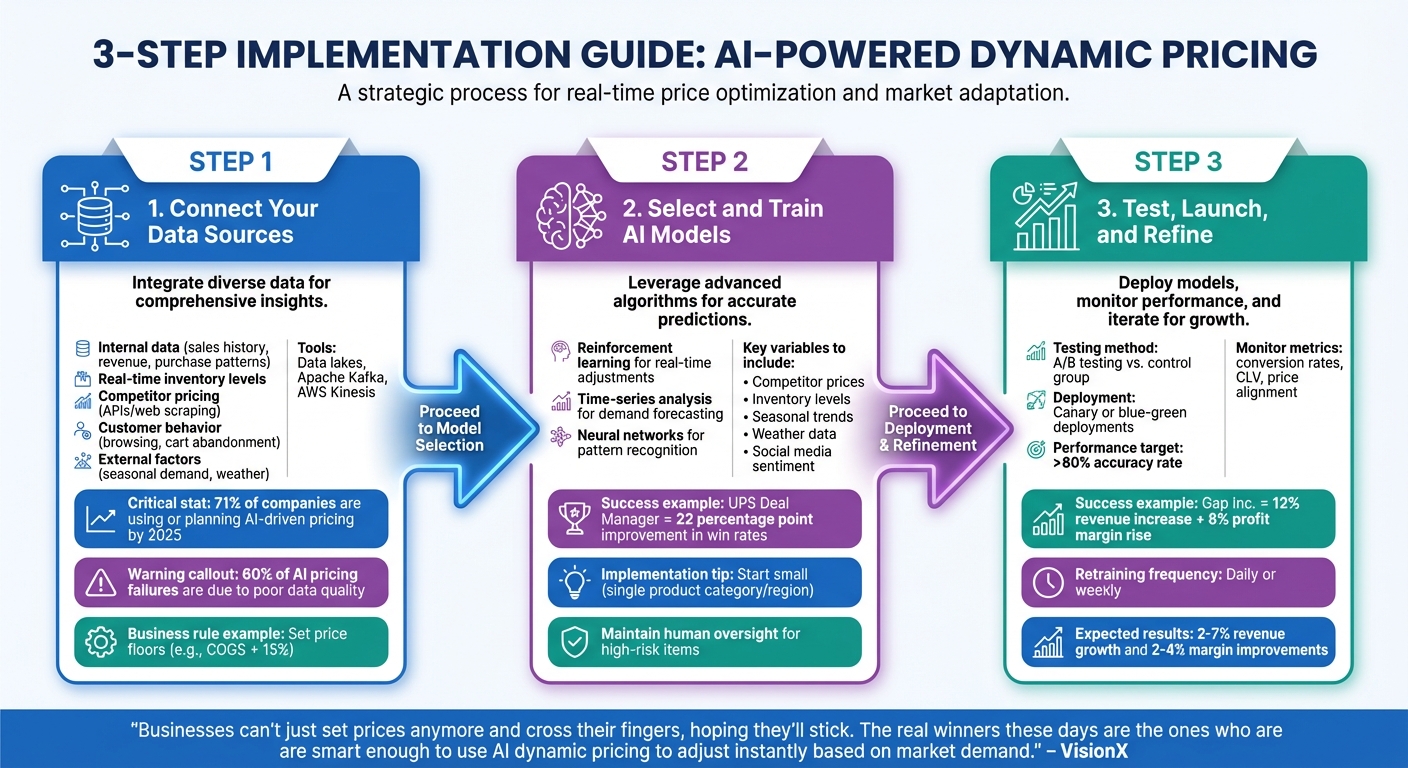
3-Step Implementation Guide for AI-Powered Dynamic Pricing
Step 1: Connect Your Data Sources
To make AI-powered pricing work, the first step is linking all your critical data streams. This means pulling together internal data like sales history, revenue figures, and purchase patterns; real-time inventory levels; competitor pricing insights from APIs or web scraping; customer behavior data (such as browsing habits and cart abandonment); and external factors like seasonal demand and even weather conditions. By 2025, 71% of companies are either using or planning to adopt AI-driven pricing solutions.
Use tools like centralized data lakes and real-time streaming platforms (e.g., Apache Kafka or AWS Kinesis) to manage your data. Ensure your pricing engine integrates seamlessly with systems like CRM, ERP, and POS to maintain consistency across the board. Keep in mind that data quality is crucial – poor data accounts for 60% of AI pricing project failures. Clean your data by addressing missing values, outliers, and anomalies.
It’s also important to set business rules early on. For instance, establish price floors (e.g., Cost of Goods Sold + 15%) to ensure profitability. Once your data is integrated and cleaned, you’ll be ready to select and fine-tune AI models tailored to your pricing needs.
Step 2: Select and Train AI Models
Different pricing problems require different AI approaches. For example, reinforcement learning works well for real-time pricing adjustments, as it learns from each transaction to optimize revenue. A notable case is UPS’s "Deal Manager" platform, which improved B2B contract win rates by 22 percentage points.
When training your models, include key variables like competitor prices, inventory levels, seasonal trends, weather data, and even social media sentiment. At the same time, implement business rules like margin floors, Minimum Advertised Price (MAP) compliance, and psychological pricing strategies (e.g., pricing ending in .99). Start small – focus on a specific product category or region where your data is strongest. For high-risk or premium items, keep human oversight in place, but allow routine adjustments to be automated.
Step 3: Test, Launch, and Refine
Once your models are trained, the next step is testing them thoroughly to ensure they perform well in real-world conditions. Use A/B testing to compare the new AI-driven pricing strategies against a control group. For example, Gap Inc. used dynamic pricing based on real-time demand and inventory data, leading to a 12% increase in revenue and an 8% rise in profit margins within the first year.
To roll out these changes, consider using canary or blue-green deployments, which allow for quick rollbacks if issues arise. Continuously monitor your model’s performance – accuracy rates should stay above 80%. Keep an eye on metrics like conversion rates, customer lifetime value, and how well prices align with your goals.
"Businesses can’t just set prices anymore and cross their fingers, hoping they’ll stick. The real winners these days are the ones who are smart enough to use AI dynamic pricing to adjust instantly based on market demand." – VisionX
Plan for regular retraining – daily or weekly – to address concept drift, where models lose effectiveness due to shifts in customer behavior. Enhance your models further by incorporating real-time signals like weather changes, social sentiment, and competitor pricing updates. Companies using advanced dynamic pricing strategies have reported 2% to 7% revenue growth and 2% to 4% margin improvements.
How Unselfish AI Supports Dynamic Pricing for Recovery
Once your AI pricing system is in place, the next hurdle is turning those insights into recovery campaigns that actually deliver results. That’s where Unselfish AI steps in, combining dynamic pricing strategies with multi-channel outreach to close the gap.
Database Reactivation with AI-Powered Outreach
Unselfish AI uses conversational SMS bots to reconnect with inactive leads in your database, offering tailored upsell deals and rebooking opportunities. By integrating directly with your CRM, it launches personalized text, voice, or email campaigns to bring dormant leads back to life. The results? AI-driven recovery efforts boast success rates between 45% and 56%, compared to the 15% industry average.
The platform segments your inactive contacts based on their last interactions and uses behavioral triggers to re-engage leads after 30 days of inactivity. High-performing campaigns have been shown to generate $75.66 in revenue per recipient – a staggering 2,000% improvement over standard email campaigns. Meanwhile, SMS-based recovery sees success rates ranging from 30% to 40%.
Dynamic pricing insights also play a vital role in addressing real-time cart abandonment, ensuring no opportunity is left on the table.
Cart Abandonment Recovery with Real-Time Pricing
With global cart abandonment rates hovering around 70% – and even higher on mobile at 85.65% – recovering these lost sales is crucial. Unselfish AI tackles this challenge with multi-channel outreach, engaging shoppers through SMS, email, and voice calls immediately after they leave their carts.
The AI system offers personalized incentives, like discounts or free shipping, to address customer concerns in real time. It even conducts interactive conversations to uncover the reasons behind abandonment, such as price sensitivity or shipping costs, and adjusts offers accordingly. With SMS open rates nearing 98%, this real-time engagement can reduce cart abandonment by up to 22% compared to traditional methods.
And here’s the kicker: businesses only pay when the AI successfully recovers a sale, thanks to Unselfish AI’s performance-based pricing model.
Voice AI for Lead Qualification and Pricing Adjustments
Unselfish AI’s voice bots take things a step further, qualifying leads, overcoming objections, and gathering valuable customer data – all without requiring human input. These bots are context-aware, meaning they know what’s in a customer’s cart, the total value, and their purchase history before making a call. This allows the system to address abandonment triggers and offer personalized adjustments, such as smart discounts or free shipping, in real time.
To maintain profitability, businesses can set strict margin limits, ensuring that pricing adjustments are always strategic and revenue-focused. This approach has proven effective, with voice AI driving a 31% boost in conversion rates compared to traditional recovery methods. Plus, it’s fully automated and continuously optimized, with Unselfish AI managing the entire process – from voice interactions to text and email campaigns – for its clients.
Key Metrics for AI-Driven Dynamic Pricing
To translate AI-driven dynamic pricing into tangible business results, it’s important to focus on metrics that reflect the effectiveness of pricing adjustments. These metrics help quantify how well strategic pricing decisions recapture lost revenue and drive growth.
Recovered Revenue
This metric highlights the financial gains from re-engaging abandoned carts, inactive leads, and churned customers. AI-powered cart recovery campaigns achieve success rates of 45–56%, far surpassing the 15% industry average for traditional email campaigns. The results speak for themselves: AI recovery campaigns generate $75.66 per recipient, compared to just $3.65 for standard email campaigns. Even better, 73% of customers recovered through AI-driven efforts make another purchase within 90 days, significantly enhancing customer lifetime value.
Take Creality, a 3D printing brand, as an example. In 2024, they used AI-driven cart recovery to automate personalized follow-ups and segment users based on behavior. This approach led to $1.2 million in recovered revenue. After assessing recovered revenue, the next step is to evaluate conversion improvements to further validate your pricing strategy.
Conversion Rate Improvements
Improving conversion rates is another critical way to measure the success of AI-driven pricing. By tailoring offers to match each customer’s willingness to pay, AI-driven pricing can boost conversion rates by 10–15%. For B2B companies, the impact can be even greater, with 10–25% improvements in quote-to-close rates. During peak times, dynamic pricing has been shown to increase conversion rates by up to 15% and raise average order values by as much as 13%.
For instance, airBaltic implemented reinforcement learning models in 2024 to replace static seat assignment fees with real-time recommendations. Within just two months, the airline saw a 6% increase in seat reservation revenue per passenger, exceeding their initial target of 2–3%. Controlled A/B testing against traditional methods confirmed the effectiveness of these AI-driven pricing adjustments.
ARPU (Average Revenue Per User) Growth
ARPU measures the revenue generated per customer and serves as a direct indicator of how well AI-driven pricing optimizes customer value. Using AI to fine-tune pricing can increase ARPU by about 8.7%, through strategies like upselling, optimized pricing tiers, and personalized offers. SaaS companies adopting dynamic pricing often see 2–5% revenue growth, while e-commerce brands experience gains of 5–10%.
A great example is Adobe Creative Cloud. By transitioning to a subscription model powered by dynamic pricing algorithms that analyze usage patterns and market segments, Adobe achieved a 44% increase in recurring revenue over three years. Additionally, dynamic pricing can improve EBITDA by 2 to 5 percentage points, ensuring that revenue growth aligns with profitability. To maintain this balance, monitoring the price realization rate – the gap between achieved prices and list prices – can help identify areas of "discount leakage" and refine pricing discipline.
| Metric Category | Key Performance Indicator (KPI) | Target/Benchmark |
|---|---|---|
| Recovery | Cart Recovery Rate | 45–56% |
| Conversion | Lead Conversion Lift | 10–15% |
| Profitability | EBITDA Growth | 2–5 percentage points |
| Value | ARPU Growth | ~8.7% |
| Efficiency | Inventory Turnover Improvement | Up to 20% |
Conclusion
AI-driven dynamic pricing has reshaped revenue recovery, turning it into a proactive, data-centric approach. By analyzing real-time data, forecasting demand shifts, and tailoring offers, businesses can reclaim revenue that might otherwise slip through the cracks. Companies using AI for dynamic pricing have reported up to 16% revenue growth, with profit margins increasing by as much as 10%.
Transitioning from manual, rule-based pricing to AI automation not only drives revenue but also relieves teams of repetitive tasks. AI systems can handle thousands of SKU-customer combinations, adjust prices in milliseconds, and identify revenue leaks 60% faster, cutting recovery time from months to weeks.
"With AI now embedded in Sales Audit, airlines can detect revenue leakage earlier, recover cash faster, and strengthen compliance." – Joshi Anthony, Chief Technology Officer for Settlement Solutions, Accelya
However, successful implementation requires clear boundaries, transparency, and consistent testing. Setting firm price limits ensures pricing strategies remain competitive without sparking damaging price wars. A/B testing helps validate AI-driven pricing against traditional methods. With 62% of consumers associating dynamic pricing with ‘price gouging’, clear communication about pricing strategies is crucial for fostering trust and loyalty.
From recovering abandoned carts to reviving dormant leads or fine-tuning B2B negotiations, AI-powered dynamic pricing equips businesses to adapt instantly to market changes while safeguarding margins. The challenge now is adopting AI pricing quickly – before your competitors do.
FAQs
What data do I need for AI dynamic pricing?
To make AI-driven dynamic pricing work effectively, start by collecting key data points like sales history, customer preferences, competitor pricing, inventory levels, and market demand trends. Adding factors like supply chain conditions, seasonal shifts, and economic indicators can refine the system even further.
This data allows AI to identify patterns, predict demand, and adjust prices in real time. The result? A system that supports revenue recovery, re-engages leads, and ensures pricing strategies remain competitive in a constantly changing market.
How do I prevent price gouging with AI pricing?
To keep AI pricing fair and prevent price gouging, it’s important to establish safeguards like price floors and rate-of-change limits. These mechanisms help ensure that prices remain reasonable and protect against exploitative practices. By putting these controls in place, businesses can promote ethical pricing and build stronger trust with their customers.
How fast can AI recover abandoned carts?
AI has the ability to recover abandoned carts almost immediately – sometimes within just seconds or minutes during the checkout process. This quick response can result in recovery rates as high as 30%, with certain tools managing to recover up to 25% of lost sales. These real-time actions play a major role in boosting conversions and helping businesses reclaim revenue effectively.