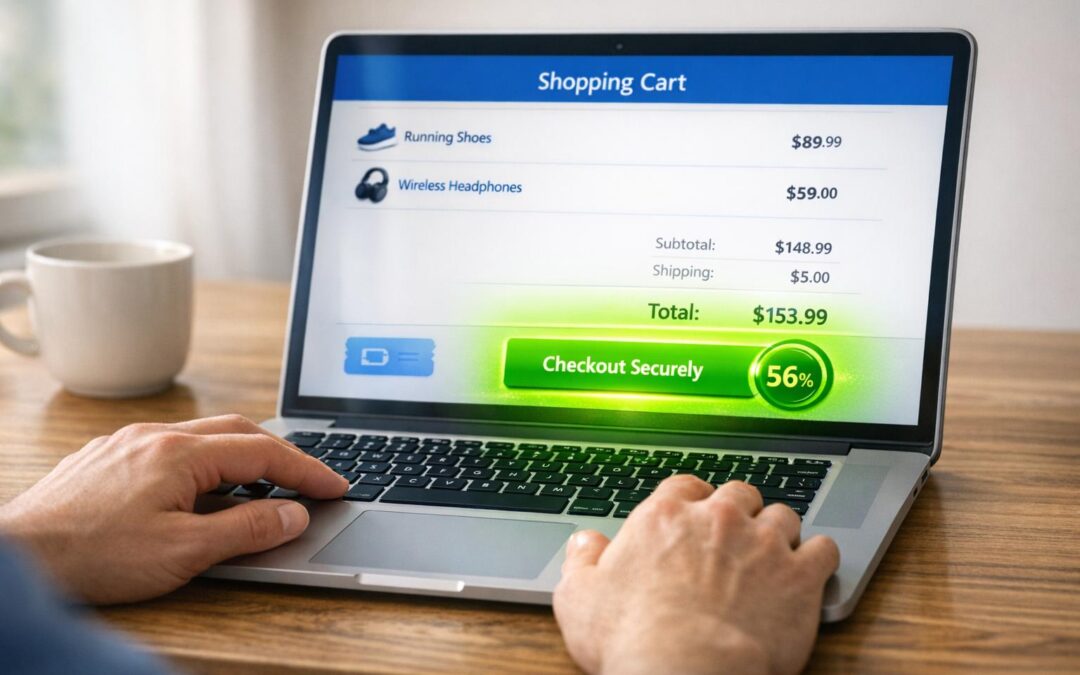
Online retailers lose $18 billion annually due to abandoned carts, with an average abandonment rate of 70.22% as of late 2025. Traditional recovery methods like follow-up emails and SMS reminders recover just 15% of lost sales. But predictive analytics offers a smarter solution: it uses AI and real-time behavior tracking to predict and prevent cart abandonment before it happens – boosting recovery rates to 45–56%.
Here’s what you need to know:
- Traditional Methods: Emails and SMS reminders sent after abandonment recover about 15% of carts.
- Predictive Analytics: AI detects abandonment signals (e.g., mouse movement, scrolling) 2–4 seconds before customers leave, triggering personalized actions like pop-ups or chatbots.
- Results: Predictive analytics generates $75.66 per recipient compared to $3.65 from email-only strategies and recovers up to 56% of abandoned carts.
Predictive analytics not only recovers more revenue but also reduces costs by targeting only at-risk shoppers. Businesses like Samsung and Yves Rocher have already seen double-digit improvements in sales using these methods.
1. Basic Cart Recovery Methods
Many e-commerce stores rely on reactive strategies to address cart abandonment, kicking in only after a customer leaves their cart behind. The most common approach? Sending reminder emails at intervals like 1, 24, and 72 hours after the cart is abandoned. Some brands also experiment with SMS and retargeting ads, but these methods all share one thing: they engage shoppers after abandonment.
Recovery Rates
How effective are these methods? Traditional email reminders recover about 15% of abandoned carts, converting roughly 3.33% of recipients and generating an average of $3.65 per email sent. SMS, on the other hand, tends to perform better, with recovery rates ranging from 30–40%, thanks to its impressive 98% open rate. Combining multiple channels – like email, SMS, and push notifications – can push recovery rates up to 20–40%.
The impact also depends on the industry. High-value sectors like automotive and home improvement often see higher returns, with some top performers generating up to $10.00 per recipient. A standout example is Creality, a 3D printing brand that, in 2024, recovered $1.2 million by using an AI-driven system to send personalized follow-ups and segment users based on their behavior.
Timing and Personalization
When it comes to cart recovery, timing is everything. Emails sent within 60 minutes of abandonment boast a 20.3% conversion rate, compared to just 12.2% when sent after 24 hours. Purchase intent drops sharply over time – from 100% in the first hour to 40% within 12–24 hours, and down to a mere 5% after 72 hours. Acting quickly isn’t just helpful – it’s essential.
Personalization also plays a critical role in boosting recovery rates. Segmenting users based on their behavior – like distinguishing casual browsers from serious buyers – allows brands to address specific concerns. For instance, if a shopper spends time on the FAQ page, the recovery message could emphasize return policies. If someone abandons their cart at checkout, highlighting transparent pricing or offering a small discount might seal the deal. Tailoring both the timing and content of recovery messages to individual behaviors can significantly improve results.
Channel Effectiveness
Beyond timing and personalization, the choice of communication channel also matters. Email remains a popular option because it’s cost-effective, but it often struggles with spam filters and promotional tabs. SMS, with its near-universal open rate of 98%, not only reaches customers faster but also converts more quickly. However, SMS has its limitations – it’s not ideal for addressing complex issues like shipping questions or product details.
Newer channels are starting to gain traction. Voice AI agents, for example, can handle real-time problem-solving for high-value carts, while WhatsApp offers context-aware conversations in regions where it’s a dominant messaging platform. The most effective recovery strategies often combine multiple channels in a cascade approach. For instance, an SMS might go out one hour after abandonment (if consent is given), followed by an email at the same time for those without SMS opt-in. Additional emails, retargeting ads, and a final follow-up email at 72 hours complete the sequence.
Some brands are already seeing impressive results with these strategies. Samsung, for example, reduced cart abandonment by 24% by using predictive triggers, web push notifications, and dynamic discounts tailored to user behavior. Similarly, Rapha Racing saw a 31% increase in purchase events by personalizing retargeting ads with customer data. These examples highlight how coordinating multiple channels based on shopper behavior can drive better outcomes.
While these reactive techniques do recover some lost revenue, they still fall short of the proactive, analytics-driven methods that will be explored next.
sbb-itb-3bca853
2. Predictive Analytics Approaches
Predictive analytics takes a forward-thinking approach, stepping beyond basic recovery tactics. Instead of reacting after a shopper leaves, this method predicts abandonment by analyzing over 50 real-time behavioral signals. These include how long someone stays on a page, how far they scroll, or even if their cursor hovers near the browser bar – often signaling an intent to exit. Using AI, these systems can predict abandonment 2–4 seconds before it happens, triggering immediate actions like chatbots or discount pop-ups to re-engage the user. This shift from reacting to predicting has led to much higher recovery rates.
Mihir Mistry, CTO of Kody Technolab, explains the impact of this proactive approach:
"Predictive analytics makes it possible to move from a reactive approach… to a proactive, preventative one".
This strategy is also cost-efficient. By targeting only those shoppers who truly need incentives, businesses can cut voucher costs by up to 25% while still increasing conversions.
Recovery Rates
The results speak for themselves. AI-powered cart recovery achieves success rates of 45–56%, far outpacing the traditional 15% rate. This improvement translates to 22 times more orders and $75.66 in revenue per recipient – a staggering 2,000% boost. Even better, 73% of these recovered customers return within 90 days.
Real-world examples highlight this effectiveness. Yves Rocher, a beauty retailer, saw an 11x increase in purchases by using real-time AI product recommendations to personalize the cart experience and reduce abandonment. Similarly, a luxury jewelry brand used AI-driven SMS and voice outreach to recover 35% of abandoned carts. Their AI agents addressed checkout hesitations through empathetic, human-like conversations.
Timing and Personalization
Predictive systems go beyond traditional recovery timelines like the standard 1-hour, 24-hour, or 72-hour email follow-ups. They use send-time optimization (STO) to engage users at the most effective moments, tailoring the timing to the reason for abandonment. For instance:
- Technical issues: Follow-ups within 5–15 minutes.
- Price concerns: Messages sent within 1–3 hours.
- Casual browsing: Outreach delayed to 48–72 hours.
AI also crafts personalized messages by analyzing browsing habits, social media activity, and hesitation points. For example, if a user spends extra time on shipping details or abandons at checkout, follow-up messages might highlight free shipping or a simplified checkout process. Harald Neuner, Co-founder of uptain, sums up this precision:
"Out of the hundreds of possible reasons to leave, what if you could identify the right one and respond with the right words, the right tone, and the right offer at exactly the right moment?"
Channel Effectiveness
Predictive analytics doesn’t rely on just one recovery channel. Instead, it coordinates efforts across multiple platforms – SMS, email, push notifications, WhatsApp, and even AI-driven voice calls. The system determines the most effective channel based on factors like the user’s device, past interactions, and the urgency of the situation.
- SMS: With a 98% open rate and an average read time of just 3 minutes, SMS works well for immediate, high-priority nudges.
- AI Voice Calls: These excel at handling more complex concerns, such as return policies, within 15–30 minutes of abandonment.
Pros and Cons
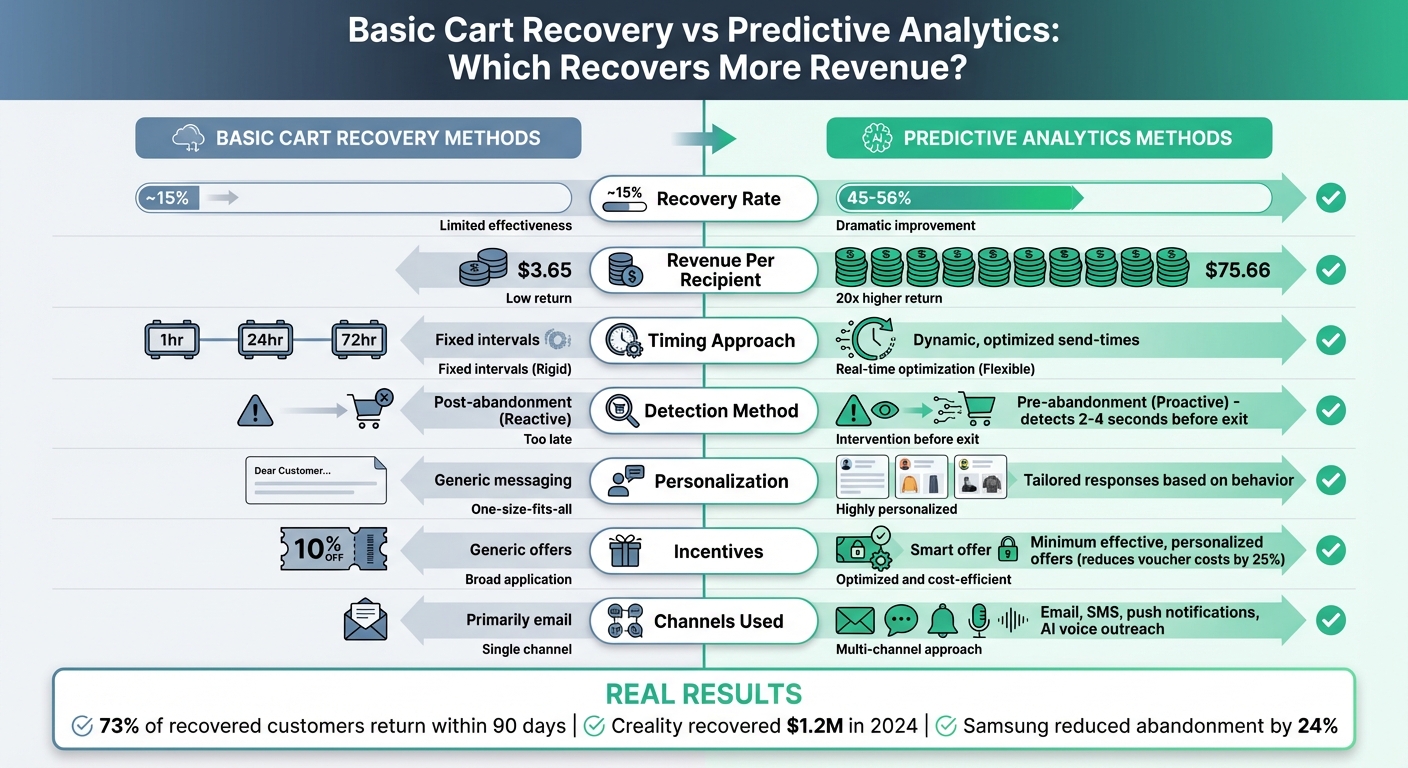
Basic Cart Recovery vs Predictive Analytics: Performance Comparison
Taking a closer look at the recovery methods, it’s clear that predictive analytics offers a significant edge over basic strategies. Basic cart recovery methods typically recover about 15% of abandoned carts by relying on reactive, scheduled reminders and generic offers. Unfortunately, these approaches can also chip away at profit margins. Predictive analytics, on the other hand, shifts the focus to real-time behavioral analysis, allowing businesses to proactively intervene and achieve recovery rates between 45% and 56%.
The key difference lies in how these methods approach timing and messaging. Basic methods stick to fixed schedules for sending reminders, often at intervals like 1 hour, 24 hours, or 72 hours after abandonment. In contrast, predictive analytics adapts dynamically, optimizing send times based on why the cart was abandoned and tailoring messages to address specific issues. This approach significantly boosts effectiveness, generating up to $75.66 in revenue per recipient, compared to just $3.65 for standard emails.
Here’s a side-by-side comparison to highlight the differences:
| Feature | Basic Cart Recovery | Predictive Analytics Methods |
|---|---|---|
| Recovery Rate | ~15% | 45–56% |
| Timing | Fixed intervals | Dynamic, optimized send-times |
| Personalization | Generic messaging | Tailored responses based on behavior |
| Incentives | Generic offers | Minimum effective, personalized offers |
| Channels | Primarily email | Email, SMS, push notifications, AI voice outreach |
| Detection | Post-abandonment (Reactive) | Pre-abandonment (Proactive) |
Though predictive analytics requires a more complex setup, the benefits far outweigh the initial investment. For instance, 73% of recovered customers make another purchase within 90 days, showcasing the long-term value of this method. Companies like Creality have reaped massive rewards, recovering $1.2 million in 2024 by leveraging predictive analytics. These results demonstrate that while the upfront effort is greater, the returns are hard to ignore.
Conclusion
Choosing between basic cart recovery and predictive analytics ultimately depends on your business’s scale and profitability goals. Basic methods are a good starting point for businesses with limited traffic, but they treat all cart abandonments the same. Generic reminders and blanket discounts may recover some sales, but they often eat into your margins. Predictive analytics, on the other hand, tailors interventions by identifying which customers need incentives and which are likely to convert without them. This approach not only protects your profitability but also recovers more sales.
As customer acquisition costs rise and 70% of online shopping carts remain abandoned, the need for smarter recovery methods becomes more pressing. Predictive analytics offers a compelling solution, boasting a potential 150x ROI on recovered revenue. For instance, Samsung’s online store reduced cart abandonment by 24% using predictive triggers and personalized strategies instead of relying on generic, time-based emails. Unlike the rigid schedules of basic recovery, predictive analytics responds dynamically to user behavior in real time.
To get started, consolidate data from website behavior, CRM records, and checkout events into a single view. Test your strategy by holding out 10–20% of abandoners from receiving messages to measure the true impact of your efforts. This will help you determine whether you’re genuinely recovering lost sales rather than just capturing organic conversions. Begin by focusing on high-value carts and customers with clear purchase intent, then scale up as your system delivers results.
The numbers speak for themselves. Predictive analytics achieves recovery rates of 45–56%, compared to just 15% with basic methods. It also generates significantly higher revenue per recipient – $75.66 versus $3.65. Performance-based solutions, like Unselfish AI, further reduce risk by charging only for recovered revenue, eliminating the need for upfront investments in infrastructure. This approach not only boosts immediate sales but also adds long-term value to your business far beyond a single cart recovery.
FAQs
What signals predict cart abandonment in real time?
Real-time indicators of cart abandonment often show up in user behavior. These can include actions like moving the cursor toward the close button, staying inactive for a while, rapid mouse movements, shallow scrolling through the page, or specific patterns in session activity. AI tools monitor these behaviors to step in at the right moment, engaging users and encouraging them to complete their purchase before they exit the site.
How do you prove recovery messages drove incremental sales?
To show that recovery messages lead to increased sales, businesses can rely on several approaches. One effective method is A/B testing, where you compare conversion rates between customers who receive recovery messages and those who don’t. Monitoring shopper behavior – like clicks or completed purchases – can also help tie sales directly to your outreach efforts. Additionally, using analytics tools to track performance and comparing revenue before and after campaigns can highlight their effectiveness. Just make sure to account for external factors to keep your results accurate.
Do I need a lot of traffic and data to use predictive analytics?
You don’t need tons of traffic or massive datasets to take advantage of predictive analytics for cart abandonment recovery. Even smaller amounts of data can be enough for AI to spot patterns and predict when a customer might abandon their cart. It does this by analyzing behavioral cues like mouse movements or session activity.
That said, having more data definitely helps. Larger datasets allow models to become more refined, which leads to more accurate predictions and higher recovery rates. The key is to prioritize quality data and continuously improve your models as your website traffic increases.