
Voice AI is transforming the way e-commerce businesses handle abandoned shopping carts. Instead of relying on emails that often go unopened, Voice AI uses real-time, automated phone calls to re-engage shoppers who left items in their carts. This approach addresses customer concerns on the spot, guiding them to complete their purchase without requiring human intervention.
Key Takeaways:
- High Cart Abandonment Rates: 65%–80% of online shoppers in the U.S. abandon their carts, leading to significant revenue losses.
- Why Voice AI Works: It uses natural, human-like conversations powered by advanced AI technologies (LLMs, NLP, STT, TTS) to resolve customer issues in real time.
- Better Results: Email recovery rates hover around 10%–15%, while Voice AI can recover up to 30% of abandoned carts.
- Cost-Effective: Though calls cost more than emails or SMS, higher conversion rates (12.3% vs. 3.1%) make Voice AI a worthwhile investment, especially for carts valued at $75 or more.
- Scalability: Voice AI handles thousands of calls simultaneously, making it ideal for peak sales periods.
By integrating Voice AI with e-commerce platforms like Shopify or WooCommerce, businesses can prioritize high-value carts, tailor conversations to customer needs, and achieve a 30× ROI. For those hesitant to invest, platforms offering performance-based pricing ensure you only pay for recovered revenue, minimizing risk.
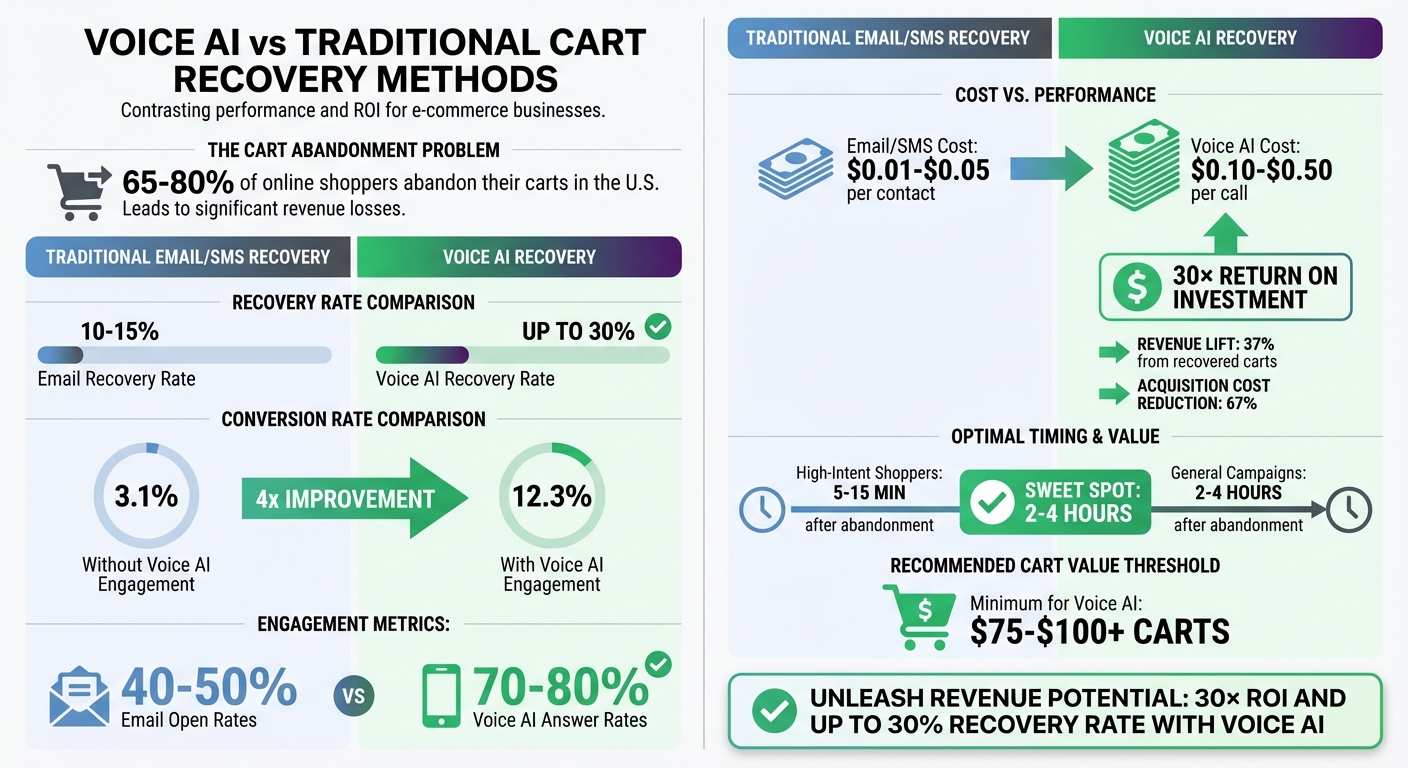
Voice AI vs Email Cart Recovery: Conversion Rates and ROI Comparison
How Voice AI Works in Cart Recovery
Voice AI has proven to be a game-changer in re-engaging warm leads, especially when it comes to recovering abandoned shopping carts. By integrating directly with e-commerce platforms, it doesn’t just send reminders – it actively interacts with customers through automated, intelligent phone conversations.
Through APIs and webhooks, voice AI monitors cart activity in real time. If a shopper adds items to their cart, provides contact details, and then leaves without completing the purchase, the system detects this immediately. From there, it kicks off a recovery workflow to bring the shopper back.
Triggering Voice AI After Cart Abandonment
When a cart is abandoned, the system collects detailed, real-time data like product names, quantities, total cart value, the customer’s purchase history, and even the exact step where they dropped off. Using this information, it determines the best recovery strategy. For instance, high-value carts – typically those exceeding $75 to $100 – are prioritized for immediate voice outreach. On the other hand, lower-value carts might start with an email or SMS before escalating to a call. This data-driven approach ensures lost sales opportunities are tackled strategically.
Timing plays a critical role here. The sweet spot for initiating a voice call is typically 2 to 4 hours after the abandonment. Calling too soon can feel intrusive, while waiting more than 24 hours risks losing the shopper’s interest entirely. If the call goes unanswered, the system automatically follows up with an SMS or WhatsApp message, complete with a one-click checkout link to simplify the process.
Once the call begins, the AI tailors the conversation to the shopper’s specific situation, making the interaction feel more personal and relevant.
Personalized Voice Interactions
Unlike outdated robocalls, today’s voice AI offers dynamic, context-aware conversations. It references specific details like the items left in the cart – mentioning product names, sizes, or colors – and addresses the shopper’s reasons for leaving. For example, if a customer mentions high shipping costs, the AI might offer expedited delivery options. If the issue was a payment error, the AI provides troubleshooting help or a direct checkout link.
Merchants can also set limits, or "margin guardrails", which cap the incentives the AI can offer. For instance, it could be restricted to offering no more than a 10% discount or free shipping for orders above $50. This ensures profitability is protected while still giving the AI enough flexibility to close the sale. By addressing specific customer concerns, these tailored interactions turn generic follow-ups into meaningful conversations.
Multi-Channel Integration
Voice AI becomes even more powerful when it’s part of a broader, multi-channel recovery strategy. For instance, a sequence might include a push notification within 30 minutes of abandonment, an email after one hour, a voice AI call for high-value carts within 2 to 4 hours, and an SMS at the 24-hour mark featuring social proof and a one-click checkout link.
The system also adapts to customer behavior. If someone opens a recovery email, it might skip the voice call to avoid over-communication. By coordinating across multiple channels, voice AI ensures a seamless recovery process that gently nudges customers back toward completing their purchase through multiple, well-timed touchpoints.
sbb-itb-3bca853
Benefits of Using Voice AI for Abandoned Cart Recovery
Voice AI takes cart recovery to a new level, offering benefits that go beyond what email or SMS campaigns can achieve. Its power lies in real-time interaction, quick problem-solving, and the ability to scale effortlessly, all of which work together to convert abandoned carts into actual sales.
Higher Engagement Rates
Phone calls grab attention in ways that emails and texts often can’t. With voice AI, businesses can engage in immediate, two-way conversations, achieving answer rates of 70% to 80% – far surpassing the 40% to 50% open rates typical for emails. This higher engagement directly leads to better conversion rates.
What sets voice AI apart is its ability to create an emotional connection. Unlike static text, voice conveys tone, empathy, and personality, which quickly builds trust, especially with first-time shoppers. On top of that, voice AI simplifies the purchasing process by allowing customers to place orders during the call or by sending one-click checkout links via SMS. This eliminates the hassle of revisiting a browser to complete the purchase. As SuperU aptly put it:
"Conversations convert better than reminders".
This kind of interaction also opens the door for real-time objection handling, making it easier to address customer concerns on the spot.
Real-Time Objection Handling
Voice AI doesn’t just engage – it actively resolves issues that may prevent a sale. It can instantly identify and address barriers, whether it’s high shipping costs, confusion about product sizes, or payment glitches. By offering immediate solutions – like expedited shipping, detailed product explanations, or direct checkout links – voice AI turns potential obstacles into opportunities.
This proactive approach delivers impressive results. While passive automation might recover only 3% of abandoned carts, voice AI can recover up to 35%. That’s a big leap, driven by the AI’s ability to handle objections in real-time.
Cost-Effective and Scalable
Though voice AI costs more per call ($0.10–$0.50) compared to email or SMS ($0.01–$0.05), its higher conversion rates make it worth the investment, especially for carts valued at $75 to $100 or more. With a 30× ROI and a 67% reduction in acquisition costs, it’s a smart choice for businesses aiming to maximize revenue.
Scalability is another standout advantage. Unlike human call centers, which are limited by staff availability, voice AI can handle thousands of calls simultaneously – perfect for peak sales periods. Platforms like Unselfish AI (https://unselfishai.com) even offer performance-based pricing, where you pay only for revenue recovered. This ensures that the service pays for itself from the start, focusing on actual results rather than just call volume.
Implementation Guide for Voice AI in Cart Recovery
Using voice AI to recover abandoned carts can turn missed opportunities into completed sales. By syncing it with your e-commerce platform, crafting effective scripts, and timing follow-ups strategically, you can boost both recovery rates and revenue.
Integration with E-Commerce Platforms
Platforms like Shopify, Magento, WooCommerce, and BigCommerce offer APIs or webhooks that can trigger voice AI calls when a customer abandons their cart. To personalize these interactions, sync customer data – such as names, cart contents, and browsing history – from tools like Salesforce, HubSpot, or marketing platforms like Klaviyo.
Set up rules to target the right customers. For instance, prioritize calls for higher-value carts, VIP customers, or first-time buyers. Tools like Unselfish AI can simplify this process by offering performance-based pricing, meaning you only pay for revenue recovered, not call volume.
Designing Effective Scripts
Once your integration is ready, the focus shifts to creating scripts that feel natural and engaging. Start calls by introducing your brand and explaining the purpose of the call within the first 5–10 seconds to build trust. Personalize the conversation with customer names, product details, and cart totals, staying within any preset incentive limits.
Dynamic scripts are key. Use branching dialogs that adjust based on customer responses. For example, if someone mentions concerns about shipping costs, the AI can offer an incentive that aligns with your profit margins. If there’s confusion about product sizing, the script should provide precise details. Setting clear guardrails – like a maximum discount – ensures incentives remain profitable. Always include an option to transfer complex issues to a live agent.
Optimizing Timing and Follow-Up
Timing is everything when it comes to abandoned cart recovery. For shoppers showing high intent, trigger calls within 5–15 minutes of cart abandonment while their interest is still fresh. For broader campaigns, waiting 1–4 hours can work well, especially if paired with an email reminder. For example, in April 2025, a mid-sized fashion retailer using Unselfish AI initiated calls two hours after cart abandonment for orders over $75. This strategy led to a 22% conversion rate and a 312% increase in recovered revenue over 90 days.
Schedule calls during local business hours (9 AM–8 PM) to ensure you’re reaching customers at a convenient time. Coordinate these calls with email and SMS campaigns. For instance, sending a "Magic Link" via SMS immediately after a successful call allows for a seamless, one-click purchase. Experiment with different timing windows to find what resonates best with your audience.
Measuring Success and Optimizing Performance
Once your campaign is live, it’s crucial to track key metrics that go beyond call volume. The goal is to confirm actual revenue recovery, which requires choosing the right benchmarks and being ready to make quick adjustments.
Key Metrics to Monitor
Start by focusing on answer rates – the percentage of calls customers pick up. Voice AI campaigns often achieve answer rates between 40% and 60%, with some platforms pushing this to 70–80%. If your rates fall below the target range, experiment with different call times or tweak caller ID settings to improve performance.
Another critical metric is the recovery rate, which measures how many abandoned carts turn into completed purchases. Businesses using AI calls typically achieve recovery rates of up to 30%, compared to the 10–15% range seen with email follow-ups. Pair this with conversation completion rates to understand how many customers stay engaged long enough to hear your pitch.
Keep an eye on total recovered revenue and calculate your ROI. Compare your costs – usually $0.10 to $0.50 per call – to the revenue generated from recovered carts. Additionally, use sentiment scores from call transcripts to gauge customer reactions and identify common objections. Don’t overlook opt-out rates; if many customers hang up or ask to be removed, it may signal issues with your script or timing. These insights will help you fine-tune your campaign before scaling it.
Simulating Performance Before Launch
Before rolling out your campaign, use these metrics and your historical data to predict outcomes. For example, if your store has 2,600 abandoned carts annually and an average order value of $80, a 12% conversion rate from AI calls could generate around $24,960 in additional yearly revenue. These projections help set realistic expectations and justify your investment.
Run a 2–4 week pilot with a 50/50 traffic split to test different script versions or call timings. Ensure your sample size is large enough to yield reliable results – using a sample size calculator can help avoid misleading conclusions.
"Failing to A/B test effectively means leaving significant potential gains – often in the range of 40-60% – on the table."
- ConversAI Labs Team
During testing, implement strict margin guardrails. For instance, limit discounts to 15% for carts under $100 and 10% for higher-value orders. In October 2025, a real estate company working with ConversAI Labs increased conversion rates by 67% in just 30 days by focusing on objection handling and initial ROI projections during rigorous A/B testing. Use historical data to simulate outcomes and refine your strategy further.
Continuous Optimization
Once you’ve launched, use your simulation insights to continuously refine your approach and improve recovery rates. Follow a systematic process: set clear success criteria, build test cases (including edge scenarios), evaluate results, identify failures, and retest after every change. Even small script tweaks can lead to unexpected results, so always run a full evaluation to ensure task success rates remain steady and latency doesn’t increase.
Research shows that delays longer than 1.5 seconds can cause customers to lose focus, with the industry average falling between 1.5 and 1.7 seconds. Don’t just monitor average latency – track the 95th and 99th percentiles to catch extreme delays that could lead to hang-ups. Dive deeper by analyzing each stage of the call pipeline to pinpoint and resolve bottlenecks.
Review call transcripts and recordings to identify where customers drop off. If you notice a pattern of hang-ups at specific points, it may be time to adjust your script or route complex issues to live agents. Testing different follow-up windows – such as calling 1 hour versus 4 hours after cart abandonment – can also yield valuable insights. Additionally, segment your performance analysis by factors like cart value to uncover trends and address potential biases in speech recognition.
Platforms like Unselfish AI simplify optimization by offering performance-based pricing, ensuring you only pay for revenue that’s actually recovered. This minimizes risk and aligns incentives. Document every failure as a test case to prevent repeating the same mistakes. Remember, optimization is an ongoing process – small, consistent improvements will drive better results over time, rather than relying on one-time fixes.
Conclusion
Voice AI is revolutionizing abandoned cart recovery by transforming static, one-way reminders into dynamic, real-time conversations. These interactions tackle common concerns – like shipping costs, payment options, and product details – right when customers are most likely to complete their purchase.
The results speak for themselves: Voice AI can recover up to 30% of abandoned carts, compared to the 10–15% typically achieved by traditional email campaigns. Shoppers who engage with voice AI agents convert at a 12.3% rate, significantly higher than the 3.1% rate among those who don’t engage. Some brands have even reported seeing a 30× return on investment and a 37% revenue lift from recovered carts. These numbers highlight how voice AI can drive both immediate and long-term revenue growth.
To get the most out of voice AI, focus on high-value carts where the potential revenue justifies the effort. Timing is key – reach out within 5–15 minutes for urgent carts and within a few hours for others. And remember, compliance matters: always secure express written consent before initiating automated calls.
As Mosharof Sabu, a Researcher and Strategic Writer, aptly states:
"The phone is still the most powerful sales tool ever invented. AI just made it scalable."
The market trends back this up. With the conversational AI market expected to grow to $41.39 billion by 2030, businesses leveraging voice AI are positioning themselves ahead of the competition.
For those hesitant to dive in, platforms like Unselfish AI offer performance-based pricing, so you only pay for results – recovered revenue. This model makes it easier to test, refine, and scale your strategy without unnecessary risk. By using these proven techniques, businesses can tap into new revenue streams and build stronger customer relationships, as outlined throughout this guide.
FAQs
Do I need customer consent before Voice AI calls?
Yes, getting customer consent is typically a must before making Voice AI calls. In the U.S., laws like the TCPA (Telephone Consumer Protection Act) require businesses to obtain clear consent for automated calls and recordings. Following these regulations isn’t just about avoiding legal trouble – it’s also about building and keeping customer trust.
What cart value is worth calling with Voice AI?
A cart value of approximately $50 or higher is generally a good benchmark for leveraging Voice AI. At this level, the chances of recovering abandoned carts improve, while also maintaining a solid return on investment (ROI).
How do I connect Voice AI to Shopify or WooCommerce?
To integrate Voice AI with Shopify or WooCommerce, you’ll need to connect the AI system to your platform through an API or a built-in integration. Once connected, you can configure it to make voice calls for abandoned carts by:
- Linking your store: Connect your Shopify or WooCommerce store to the Voice AI system.
- Defining triggers: Set up specific triggers based on cart activity, like when a cart is abandoned.
- Customizing scripts and schedules: Tailor the outreach scripts and decide the best timing for calls.
Many platforms also offer step-by-step setup guides to help you through the process.