Reactivating dormant leads is cheaper and more profitable than acquiring new customers. Behavioral segmentation – grouping leads based on actions like purchase history or engagement – makes reactivation campaigns more effective by delivering targeted, relevant messages. For example, Showmax boosted subscribers by 204% in 2025 using this approach, while Too Good To Go saw a 135% rise in purchases.
Why It Works:
- Relevance matters: Leads inactive for a week need different messaging than those silent for months.
- Personalized outreach: Behavioral data like pricing page visits or cart abandonment reveals intent.
- Cost-effective: Reactivating users costs 5x less than acquiring new ones and can deliver 25% higher lifetime value.
Key Steps:
- Analyze behavior: Identify patterns like cart abandonment or feature drop-offs.
- Segment leads: Group by inactivity duration, engagement level, or intent signals.
- Prioritize with AI: Score leads to focus on those most likely to convert.
- Create multi-channel campaigns: Use email, SMS, or voice outreach tailored to each segment.
Behavioral segmentation transforms reactivation into a targeted, data-driven strategy that maximizes ROI while keeping costs low.
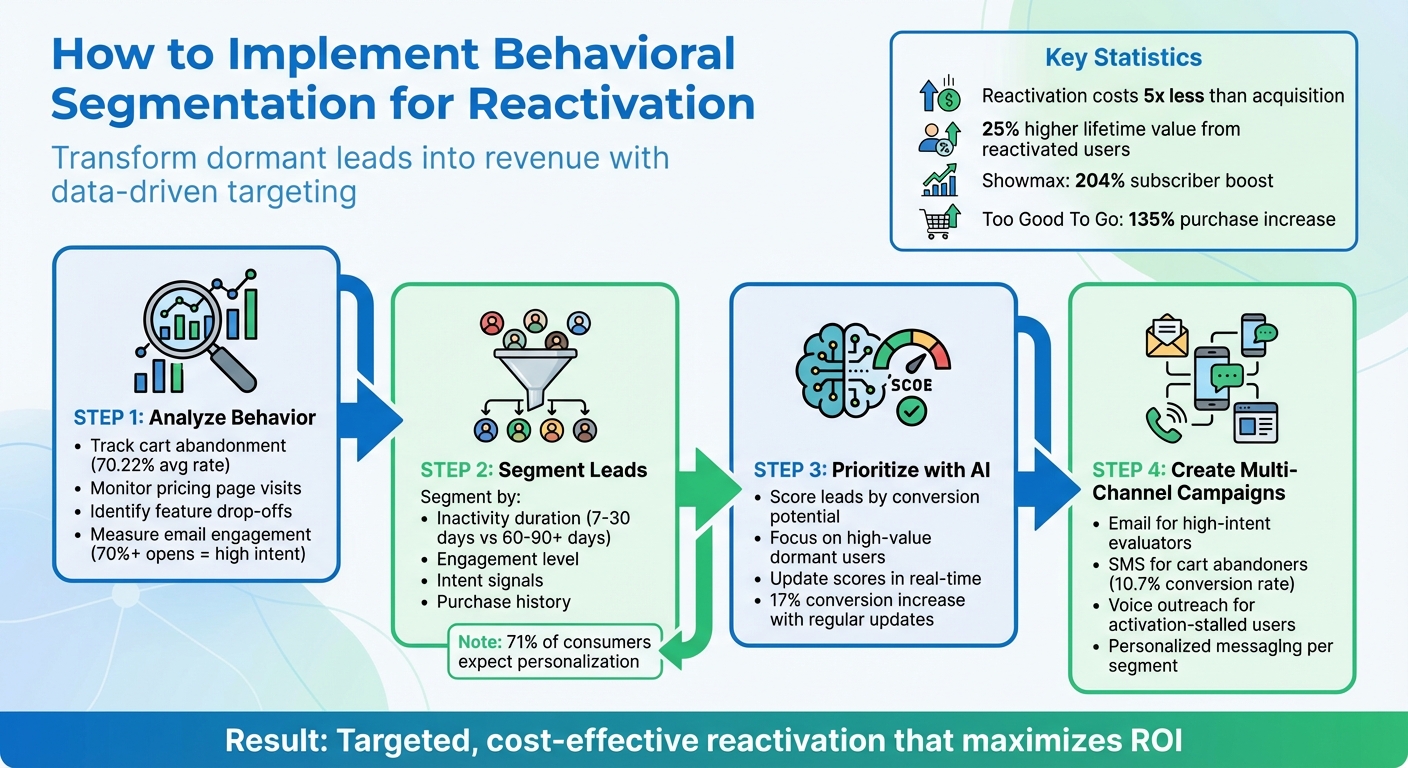
4-Step Behavioral Segmentation Process for Lead Reactivation
What Is Behavioral Segmentation in Database Reactivation?
Behavioral segmentation focuses on grouping leads based on their actions – like purchases, website activity, or feature usage – rather than relying solely on static traits such as age or job title. Instead of guessing how someone might behave based on demographics, this approach uses actual behavior patterns to guide decisions. For example, if a customer frequently visits your pricing page, abandons their cart due to shipping costs, and regularly clicks on "sale" emails, their behavior provides clear insights into their intentions and pain points. This method enables precise, targeted reactivation strategies.
When it comes to reactivation campaigns, inactivity is seen as a spectrum rather than a single state. A user who has been quiet for just a week might only need a small nudge or a reminder about a useful feature. On the other hand, someone inactive for 90 days or more may require a more thorough re-onboarding process to reconnect them with your value.
"Dormancy is not a single state. It’s a spectrum. Effective reactivation doesn’t start with messaging. It starts with segmentation."
Key behavioral signals to monitor include recency, engagement frequency, and purchase history. For SaaS companies, tracking feature-specific drop-offs – like when a user stops engaging with a core workflow – can help you deliver tailored assistance rather than sending generic "we miss you" messages.
A great example of this in action is Ducks Unlimited Canada, which managed to double its email click-through rates in just three months using behavioral segmentation. Additionally, research shows that 71% of consumers expect personalized interactions, and 76% feel frustrated when they don’t receive them. By tailoring your segments, you can create campaigns that maximize ROI.
| Segment Type | Typical Profile | Recommended Strategy |
|---|---|---|
| Recently Dormant | Inactive 7–30 days; still familiar with the product | Gentle nudges, feature reminders, and use case reinforcement |
| Long-Term Dormant | Inactive 60–90+ days; disconnected from value | Re-onboarding flows, reframing value, and possible incentives |
| High-Value Dormant | Large accounts with a history of high engagement | Personalized outreach with a human touch |
| Trial Drop-Offs | Users who never reached activation | Activation walkthroughs and friction-reducing efforts |
These segment profiles serve as a foundation for the multi-step reactivation strategies discussed in the next section. By understanding and addressing the specific needs of each group, you can craft campaigns that feel personal and effective.
sbb-itb-3bca853
How to Implement Behavioral Segmentation for Reactivation
Step 1: Analyze Dormant Leads Using Behavioral Data
Start by diving into behavioral signals like email open rates and website interactions to measure intent. For example, frequent visits to pricing pages or extended time spent on high-value pages such as ROI calculators or product specs often signal strong buying interest.
Look at your funnel data to pinpoint where leads drop off – whether it’s demo requests that don’t lead to purchases, abandoned carts, or incomplete forms. In SaaS, patterns like login frequency or how users engage with specific features can help distinguish between power users and those who never found value. These insights can guide you on which leads to prioritize.
For instance, research shows that leads who open 70% or more of emails are more likely to convert. Additionally, the global cart abandonment rate hovers around 70.22% – a massive opportunity for reactivation.
To keep your data consistent across teams, use standardized event names like Pricing_Viewed or Cart_Abandoned. Focus your efforts on leads who were active within the past six months, as they’re more likely to re-engage than those inactive for years. Implement a rolling 30-day scoring system to ensure your team prioritizes the most relevant opportunities. These steps help establish clear reactivation segments.
Step 2: Define Behavioral Segments for Targeting
Create segments based on behavioral signals that reveal intent. For example, someone who visits the pricing page three times in 48 hours might need a different approach than someone who hasn’t interacted in 90 days.
"If you cannot articulate exactly what you will do differently for each segment, the segmentation is not done yet."
Align each segment with a specific moment in the customer journey. For example, users inactive for over 30 days might benefit from a re-engagement campaign, while frequent browsers showing high intent could be sent a direct offer. Incorporating qualitative feedback, like asking why a user didn’t complete onboarding, can also help fine-tune your approach.
| Reactivation Segment | Behavioral Signal | Actionable Response |
|---|---|---|
| Churn Risks | No login for 7+ days; ignored recent launches | Launch a win-back campaign with reactivation nudges |
| Silent Cart Abandoners | Added items to cart; no checkout for 3 days | Send urgency-driven SMS or emails with social proof |
| Activation-Stalled | Started onboarding but skipped key steps | Provide in-app guides or support call-to-actions (CTAs) |
| High-Intent Evaluators | Viewed pricing page 3+ times in 48 hours | Send ROI calculators, case studies, or direct offers |
Table source:
Step 3: Use AI to Score and Prioritize Segments
Once you’ve defined your segments, use AI tools to score and prioritize them based on conversion potential. AI models can analyze multiple data points to assign scores that reflect each segment’s likelihood to convert. For example, actions like visiting a pricing page might carry more weight than simply opening an email.
By combining demographic, firmographic, and behavioral data, you can create a more accurate scoring system. Businesses that regularly update their lead scoring models report a 17% increase in conversion rates. To avoid overwhelming your team, set scoring thresholds that match your capacity and refine criteria to reduce false positives.
Platforms like Unselfish AI use performance-based scoring to identify high-value dormant leads, enabling you to focus your outreach efforts where it matters most. The platform updates scores in real time as new behaviors occur, ensuring your data stays current.
Step 4: Design Personalized Multi-Channel Campaigns
Tailor your outreach to each segment using their preferred communication channels. For example:
- High-intent evaluators might respond best to emails featuring ROI calculators or case studies.
- Cart abandoners could be reached with urgency-driven SMS messages that highlight social proof.
- Activation-stalled users might benefit from voice outreach offering personalized support.
Abandoned cart emails alone have a conversion rate of 10.7%, which is significantly higher than the average ecommerce rate of 1.9–2%. Plus, personalized experiences can lead to customers being 1.8 times more likely to pay a premium and 3.7 times more likely to make additional purchases. Reactivating dormant leads is also 3 to 10 times cheaper than acquiring new customers.
Unselfish AI simplifies multi-channel campaigns by integrating SMS, email, and voice AI outreach. With a pay-for-results model, you only invest in what works – whether it’s recovered revenue or booked calls. Campaigns can be launched quickly, and the platform handles sequencing across channels automatically. By leveraging this approach, you can maximize reactivation ROI while scaling your efforts efficiently.
Measuring and Optimizing Reactivation ROI
Once you’ve implemented behavioral segmentation, the next step is measuring key metrics to ensure your reactivation strategy delivers the best possible return on investment (ROI).
Start by tracking your reactivation rate – the percentage of inactive users who re-engage or make a purchase. Combine this with conversion rates to see if your messaging is driving the desired actions. If there’s a gap between the two, it might signal that your offer or messaging needs tweaking.
Another crucial metric is revenue per reactivated subscriber. This helps confirm that your incentives are still profitable. To calculate it, divide the total campaign revenue by the number of users who re-engage. Also, compare your cost per reactivated lead (CPRL) with the cost of acquiring new customers. Reactivation often costs about five times less than acquisition. Keep an eye on Customer Lifetime Value (LTV) uplift, as reactivated users can deliver up to 25% more lifetime value than brand-new customers.
A/B testing is essential for refining your approach. Experiment with variables like dormancy thresholds (e.g., 30 days vs. 60 days), subject line styles, or incentive timing. Segmented A/B testing, in particular, has been shown to boost ROI by 37% compared to non-segmented methods. Evaluate your campaigns over a 30- to 60-day period to account for delayed conversions. Monthly reviews, rather than daily checks, can help you spot long-term trends in win-back rates and revenue contributions. These insights allow you to fine-tune your strategy and keep your reactivation efforts efficient.
It’s also important to monitor email deliverability metrics, like bounce rates and sender reputation, to ensure your campaigns don’t harm your email infrastructure. Set engagement thresholds to avoid over-messaging, which can lead to unsubscribes or spam complaints. Focus on users who have been dormant for three to six months, as they typically offer the highest ROI compared to those inactive for over 180 days.
Conclusion
Behavioral segmentation turns database reactivation into a highly targeted revenue generator. By focusing on customer actions rather than demographics, businesses can deliver the right message at just the right moment – bringing dormant leads back to life as active buyers. Plus, reactivating old leads is far more cost-effective, running 5–7 times cheaper than acquiring new customers. Even better, reactivated users tend to deliver 25% higher lifetime value compared to brand-new prospects.
The best way to get started? Begin with smaller, high-impact segments. For example, prioritize recently inactive users over those who’ve been dormant for years. Tie these groups to specific revenue goals, and craft offers based on their position in the customer journey. This approach avoids unnecessary discounts for leads who may just need a small push, helping protect profit margins while increasing conversions.
Once your segmentation is in place, advanced automation tools can take your efforts to the next level. Platforms like Unselfish AI streamline the process by automating tasks like identifying patterns, scoring leads in real time, and managing outreach across multiple channels like SMS, email, and voice. Their pay-for-results model means you only pay for measurable outcomes, such as recovered revenue or booked calls, making it a low-risk way to tap into the unutilized potential of your database.
With 50–70% of leads in most databases sitting idle or underutilized, the opportunity for reactivation is massive. Success comes from treating reactivation as a strategic focus – using behavioral data to reach the right audience with the right message at the right time. By pairing precise segmentation with AI-driven outreach, businesses can turn dormant leads into a steady stream of revenue, ensuring every interaction adds value and drives results.
FAQs
Which behaviors should I track first for reactivation?
To encourage customer reactivation, keep an eye on behaviors like website visits, abandoned carts, recent purchases, and email activity (such as opens and clicks). These actions provide insight into who’s engaged and who’s not, making it easier to identify the right audience for your campaigns. For instance, an abandoned cart shows interest but no follow-through, while minimal email interaction might signal the need for a re-engagement push. By tracking these patterns, you can tailor your outreach efforts to be more targeted and effective.
How do I choose the right dormancy cutoff for each segment?
To figure out the right dormancy cutoff, match the inactivity period to your customer lifecycle and what’s typical for your industry. Many companies treat subscribers as dormant after 6–12 months of no activity, but this can differ depending on the sector. Adjust your cutoff by analyzing customer behavior, engagement trends, and the cost of reactivation efforts. The goal is to strike a balance between minimizing customer loss and maximizing the chances of re-engagement.
What’s the best way to score and prioritize dormant leads?
To tackle dormant leads effectively, start by defining what "dormant" means for your business. For example, it could refer to leads with no activity for 90–180 days. Next, use behavioral data to segment these leads based on their value and the likelihood they’ll re-engage. Once you’ve identified high-potential contacts, implement targeted and respectful multi-touch campaigns. These could include a mix of emails, ads, and personalized outreach efforts. This approach not only safeguards your email deliverability but also helps you focus on conversions and get the most out of your reactivation efforts.