

Dynamic content transforms marketing by tailoring messages to individual users in real time. Unlike static content, it adjusts based on factors like location, browsing behavior, and purchase history, creating a more personalized experience. This approach has proven results:
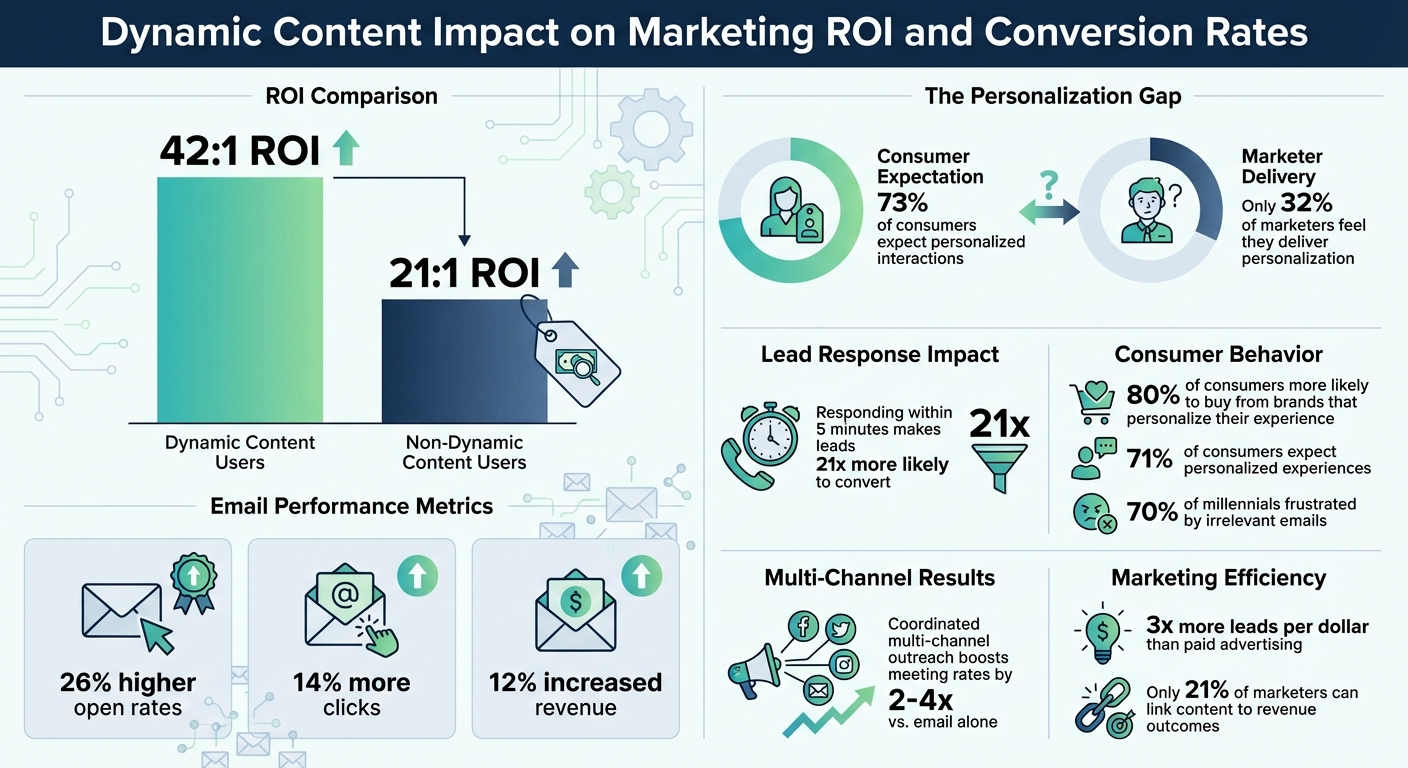
- 42:1 ROI for brands using dynamic content regularly, compared to 21:1 for those who don’t.
- Emails with dynamic elements see 26% higher open rates, 14% more clicks, and 12% increased revenue.
- 73% of consumers expect personalized interactions, yet only 32% of marketers feel they deliver.
Dynamic content works across email, SMS, and voice channels, using tools like AI and CRM data to optimize engagement. It boosts conversions by personalizing messages, targeting leads at the right stage, and automating follow-ups. Businesses can measure success through metrics like lead-to-customer conversion rates and revenue per email.
Key takeaway: Personalized, real-time messaging is no longer optional – it’s a must for meeting customer expectations and driving growth.
Dynamic Content Impact on Marketing ROI and Conversion Rates
What Is Dynamic Content and How Does It Work?
Dynamic content is designed to change in real time based on who’s viewing it. Unlike static content, which stays the same for everyone, dynamic content adapts elements like text, images, calls-to-action, and even entire layouts to match a person’s preferences, behavior, demographics, location, or stage in the buying process.
Think of it as a smart template that assembles itself on the spot. When someone opens an email or visits a webpage, the system taps into their profile and applies specific rules. For instance, someone in California might see one version of a message, while someone in New York sees another. Once set up, the process runs automatically.
"Dynamic content is email or website content that automatically changes based on who’s viewing it. Instead of sending the same message to everyone, you show each person content tailored to their data, preferences, or behavior." – ActiveCampaign
This system pulls data from your CRM, including tags, custom fields, purchase history, web activity, and location. It can even factor in contextual details like device type, time of day, or IP address to fine-tune what’s displayed. The goal? To create a personalized experience that feels like a one-on-one conversation, not a generic broadcast.
Key Features of Dynamic Content
Here are some standout ways dynamic content enhances user interactions:
- Adaptive CTAs: Call-to-action buttons change depending on the user’s relationship with your brand. For example, a new visitor might see “Start Free Trial,” while a returning customer could get options like “Explore New Features” or “Log In”.
- Location-Based Personalization: Using IP addresses, dynamic content can show weather-appropriate products, nearby store details, or region-specific shipping info. For instance, a clothing retailer might promote winter coats to someone in Minnesota and swimwear to someone in Florida – all using the same campaign template.
- Behavioral Recommendations: Tailor content based on browsing history, past purchases, or searches. In 2022, Target used this approach to recommend recently viewed accent chairs, helping guide shoppers toward a purchase. Similarly, Lulus offered geo-targeted “Free US Shipping,” lifecycle-based discounts for first-time visitors, and a “Give $20, Get $20” referral campaign.
- Progressive Profiling: This method collects data more effectively by skipping questions a user has already answered and introducing new ones during each interaction. It builds a detailed profile over time without overwhelming the user.
Dynamic Content vs. Static Content
Static content, like logos, footers, blog posts, and brand descriptions, stays the same for everyone. It’s simple to create and upload but requires manual updates to stay current. While great for consistency and SEO, it doesn’t offer the personalized touch that users increasingly expect.
Dynamic content, on the other hand, adjusts automatically for each viewer. Though it takes more effort to set up, it runs on autopilot once live. The benefits are clear: it reduces bounce rates, keeps visitors engaged longer, and drives conversions by showing users exactly what they need.
| Feature | Dynamic Content | Static Content |
|---|---|---|
| Nature | Adapts automatically to the viewer | Remains the same for everyone |
| Primary Goal | Relevance, engagement, and conversion | Consistency, brand awareness, and SEO |
| Best Use Cases | Product recommendations, abandoned cart emails, personalized greetings, smart CTAs | Logos, footers, blog posts, brand descriptions |
| Maintenance | Complex to set up but easy to maintain once live | Easy to prepare but requires manual updates |
| Performance | Improves bounce rates and increases time on page | Provides a consistent baseline experience |
This difference matters more than ever. A study found that 71% of consumers now expect brands to deliver personalized experiences. On the flip side, 70% of millennials feel frustrated when they receive irrelevant emails. Static content alone can’t meet these expectations – dynamic content delivers the tailored experiences today’s audiences demand.
Next, we’ll dive deeper into how dynamic content boosts lead conversions by enhancing personalization, timing, and engagement.
sbb-itb-3bca853
How Dynamic Content Improves Lead Conversion Rates
Dynamic content tailors your messaging to fit each lead’s unique journey, drawing on their actions, preferences, and stage in the buying cycle. The result? Greater engagement, stronger trust, and higher conversion rates.
Personalization and Relevance
Dynamic content’s real power lies in its ability to adapt automatically. When someone visits your site or opens an email, the system taps into data from your CRM – like past purchases, browsing behavior, or location – to create a personalized experience designed to convert. It’s not just about using their name; the content itself shifts to focus on what’s most relevant to them.
For instance, imagine a user adds a high-ticket item to their cart but doesn’t finalize the purchase. The next email they receive could highlight that specific item with a tailored discount or incentive to close the deal. AI takes this even further by creating micro-segments, such as targeting users who abandoned carts worth over $200 in the last six hours, enabling hyper-focused messaging.
Targeting Leads at the Right Stage
Generic drip campaigns are outdated. Today’s lead nurturing demands content that aligns with where a lead is in their journey – whether they’re just discovering your brand or are ready to buy. Early-stage prospects benefit from educational content that introduces your value, while those closer to conversion need messaging that addresses their specific concerns or objections.
Dynamic content automates this process. For example, new subscribers might receive a welcome sequence packed with helpful resources, while leads further down the funnel get targeted offers or testimonials to build trust and drive action. By delivering the right message at the right time, you not only nurture leads effectively but also speed up the path to revenue.
AI-Powered Optimization
AI takes dynamic content to the next level by transforming it into a system that constantly improves itself. By analyzing customer behavior and intent, AI enables businesses to deliver highly personalized experiences to thousands of leads at once. Predictive models help pinpoint what a lead is likely to purchase, assess their risk of leaving, and estimate their long-term value. This lets you adjust your content proactively to keep their interest.
What’s more, AI learns from every interaction – testing and refining elements like headlines, images, and calls-to-action – to make each campaign smarter and more effective. This means better results with less manual effort, giving you a powerful tool to boost conversions.
Using Dynamic Content Across Multi-Channel Sequences
Reaching leads through a single channel just doesn’t cut it anymore. Dynamic content shines when it adapts seamlessly across email, SMS, and voice outreach, creating a unified experience that connects with prospects wherever they are. The key? A single decision engine that reacts to real-time signals, choosing the next best action instead of blasting out the same message everywhere.
"Repeating your message on every channel is not multi-channel, that’s spam with better distribution."
- Joey Gilkey, CEO, TitanX
Coordinated multi-channel outreach can boost meeting rates by 2–4× compared to relying on email alone. This method lays the groundwork for deeply personalized interactions, particularly through email and SMS.
Email and SMS Personalization
Dynamic email and SMS go far beyond just adding a name to the subject line. Merge tags can pull in firmographic details – like company size or industry – to craft messages that address specific pain points. For instance, a marketing manager at a Series B SaaS company might get content about scaling challenges, while a sales director at a large enterprise might see messaging focused on improving pipeline efficiency.
Spintax helps rotate phrases to dodge spam filters. Meanwhile, advanced elements like real-time countdown timers or activity-based images can make emails more engaging. For example, campaigns using countdown timers to highlight expiring offers have seen sales jump by 332%. Real-time content strategies, in general, have been shown to boost revenue by 9% on average.
Conditional logic takes personalization even further. If a lead’s IP address suggests they’re in California, the email might show webinar times in Pacific Time and prices in U.S. dollars. A lead in Texas might see Central Time instead. This automated localization keeps the experience relevant without the headache of creating separate campaigns for each region. And while email and SMS set the stage, voice AI can take personalization to the next level.
Voice AI for Lead Engagement
Voice AI brings dynamic content into real-time conversations, using adaptive scripts that adjust based on a lead’s responses. Unlike rigid phone trees, these systems can pivot based on intent signals, such as a recent visit to a pricing page or an abandoned cart.
High-intent actions trigger immediate voice outreach, ensuring quick follow-up. For example, if a prospect downloads a case study, the system can initiate a call within 30 minutes while their interest is still fresh. The AI references the prospect’s specific behavior, making the conversation feel personal and relevant – something static scripts just can’t replicate.
Voice AI also takes care of lead qualification, sends reminders, and collects data, all without tying up your team’s time. It learns from every interaction, constantly refining its approach and enabling scalable, personalized outreach to thousands of leads at once. This adaptability is a perfect example of how dynamic content can drive stronger engagement.
Unselfish AI‘s Multi-Channel Sequencing
Unselfish AI brings all these elements together, integrating dynamic content across email, SMS, and voice into a single, coordinated system. With its performance-based model, you only pay for results – like recovered revenue or booked calls – making it a low-risk way to implement multi-channel strategies [unselfishai.com].
The platform uses branching logic to adjust in real time. If a lead opens an email but doesn’t respond, the system shifts to SMS or voice outreach. If the lead replies or books a meeting, all automation stops immediately to avoid over-contacting. For reactivating old databases, SMS bots send personalized offers based on past interactions, while cart abandonment triggers multi-channel follow-ups referencing specific products and offering tailored incentives.
Voice AI then steps in with natural-sounding calls, serving as a friendly reminder rather than a hard sell. The entire system is quick to deploy – up and running in days – and scales effortlessly to handle your lead volume [unselfishai.com].
Measuring the ROI of Dynamic Content
Once you’ve implemented dynamic content across your channels, the next step is understanding its impact. Measuring its return on investment (ROI) is crucial to ensure your personalization efforts are effective and worthwhile.
Only 21% of marketers can accurately link content consumption to revenue outcomes. Without proper measurement, the true ROI of your dynamic content remains unclear. To bridge this gap, connect GA4 analytics to your CRM using the Client ID from conversion forms. This setup allows you to directly link content interactions to closed deals. Use a minimum 90-day attribution window and compare results with a non-personalized control group to confirm that any performance boost is genuine.
Key Metrics to Track
Instead of relying on vanity metrics, focus on those that tie directly to revenue:
- Lead-to-customer conversion rate
- Revenue per email (RPE)
- Click-to-open rate (CTOR)
- Pipeline influence value (monetary value of deals involving dynamic content)
- Cost per assisted conversion
- Engagement indicators (e.g., scroll depth of 75%+ or time on page exceeding 3 minutes)
- CFO-level metrics like average order value and customer lifetime value
To calculate your personalization ROI, use this formula: (Revenue Lift + Cost Savings) / Total Investment. Be thorough – factor in all costs, including labor (hours worked × hourly rate), promotional expenses, and ongoing maintenance, not just software subscriptions. It’s worth noting that content marketing generates three times more leads per dollar than paid advertising, but this advantage often goes unnoticed without proper tracking. The more accurate your ROI tracking, the easier it becomes to refine your dynamic content strategy and drive even better results.
Tools for Measuring Dynamic Content Performance
To measure performance effectively, combine tools for analytics, visualization, and personalization:
- GA4: Provides behavioral tracking and multi-touch attribution.
- Looker Studio: Creates executive dashboards to visualize key metrics.
- Personalization platforms: Tools like Optimizely, Dynamic Yield, and Adobe Target include built-in analytics, while Hushly specializes in B2B tracking.
- Email marketing tools: Platforms such as ActiveCampaign, MailChimp, and Campaign Monitor track email-specific performance.
Integration is critical. By connecting your CRM (e.g., Salesforce or HubSpot) to these tools, you can link content engagement directly to revenue outcomes. Consistent UTM parameters across email, SMS, and social channels help create clear digital trails back to revenue. Use standardized naming for utm_source, utm_medium, and utm_campaign to simplify attribution.
Another key consideration: 67% of emails are opened on mobile, but 58% of purchases happen on desktop. Your tools need to maintain attribution across devices to avoid underestimating ROI by as much as 34%. Automated dashboards that sync engagement data with your CRM in real time make ROI tracking smoother. For example, Unselfish AI’s performance-based model provides real-time insights into recovered revenue, booked calls, and other results, making ROI measurement straightforward and actionable.
Conclusion
Dynamic content is a game-changer for boosting ROI and speeding up conversions by tailoring outreach in real time. The numbers speak for themselves: responding to a lead within five minutes makes them 21 times more likely to convert. As Brian Halligan, Co-founder of HubSpot, aptly stated:
"Consistency is key. If you’re not following up in a timely manner, you’re missing opportunities"
Dynamic content takes the guesswork out of this process by automating personalized communication across email, SMS, and voice channels – ensuring every lead gets the right message at the right moment.
To get started, focus on implementing a single dynamic element, then expand as performance data confirms its value. Keep your CRM data clean, use progressive profiling to enrich lead insights over time, and monitor key metrics like lead-to-customer conversion rates and revenue per email. The tools to scale personalization effectively and affordably are already available.
For businesses hesitant about upfront investment, Unselfish AI offers a performance-based model. You only pay for results, like recovered revenue, booked calls, or re-engaged leads. Their multi-channel AI automation tackles tasks like database reactivation, cart abandonment recovery, and voice outreach. Best of all, campaigns can be launched in just days, delivering quick, measurable results.
With 80% of consumers more likely to buy from brands that personalize their experience, businesses that stick to static content risk falling behind. Personalized, timely messaging isn’t just a nice-to-have – it’s now a critical factor in meeting customer expectations, driving engagement, and achieving long-term growth.
FAQs
What data do I need to start using dynamic content?
To make dynamic content work effectively, you’ll need access to data such as user behavior, preferences, demographics, browsing history, and contextual details like location or industry. This data enables you to create personalized and targeted messages, which can significantly boost engagement and drive better conversion rates.
How do I add dynamic content without rebuilding my whole sequence?
You can make your content more engaging by using variables or personalization tokens to include specific details, like a contact’s name or company information, directly in your messages. For example, placeholders like {{BUYER.ACCOUNT.NAME}} let you update content dynamically without needing to change the overall structure of your sequence. This approach keeps your workflow smooth and allows for quick, efficient updates while maintaining a personalized touch.
How can I prove dynamic content is driving revenue?
Dynamic content can clearly show its impact on revenue by influencing critical metrics such as engagement, click-through rates, and conversions. By using tools like A/B testing or reviewing case studies, you can compare results before and after implementing dynamic content. For instance, campaigns leveraging dynamic content have demonstrated measurable increases in conversion rates, proving its effectiveness as a tool to enhance ROI.